A pandemic of the novel coronavirus has now killed more than 1.3 million people worldwide.
Over 53.2 million people across the globe have been diagnosed with COVID-19, the disease caused by the new respiratory virus, according to data compiled by the Center for Systems Science and Engineering at Johns Hopkins University. The actual numbers are believed to be much higher due to testing shortages, many unreported cases and suspicions that some national governments are hiding or downplaying the scope of their outbreaks. The criteria for diagnosis -- through clinical means or a lab test -- has also varied from country to country.
Since the first cases were detected in China in December, the virus has rapidly spread to every continent except Antarctica. The United States is the worst-affected nation, with more than 10.7 million diagnosed cases and at least 244,283 deaths.
Nearly 200 vaccine candidates for COVID-19 are being tracked by the World Health Organization, at least 10 of which are in crucial phase three studies. Of those 10 potential vaccines in late-stage trials, there are currently five that will be available in the United States if approved.
Here's how the news is developing. All times Eastern.
Nov 12, 2020, 5:52 AM EST
Russia sees record high deaths for 2nd straight day
Russia registered 439 deaths from COVID-19 in the last 24 hours, setting a new single-day record for the second straight day.
An additional 21,608 new cases of COVID-19 were also confirmed nationwide over the past day. Russia's cumulative total now stands at 1,858,568 cases with 32,032 deaths, according to the country's coronavirus response headquarters.
Moscow remains the epicenter of the country's outbreak and recent surge. Nearly 28% of the newly confirmed cases -- 5,997 -- and over 16% of the new deaths -- 71 -- were reported in the capital, according to Russia's coronavirus response headquarters.
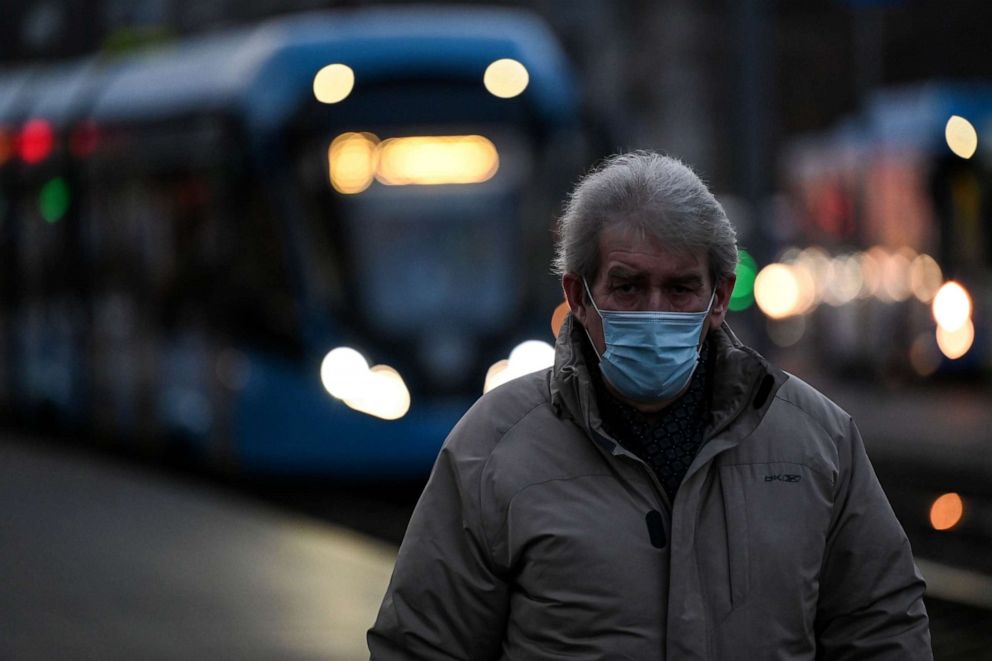
A man wearing a face mask to protect against the novel coronavirus waits for a tram on a tram stop in Moscow, Russia, on Nov. 11, 2020.
Kirill Kudryavtsev/AFP via Getty Images
Despite the growing number of infections and deaths, Russian authorities have repeatedly said they have no plans to impose another nationwide lockdown.
The Eastern European country of 145 million people has the fifth-highest tally of COVID-19 cases in the world, behind only the United States, India, Brazil and France, according to a real-time count kept by Johns Hopkins University.
ABC News' Alina Lobzina contributed to this report.
Nov 12, 2020, 5:01 AM EST
7 dead, 140 others sick in outbreak at Illinois veterans home
A COVID-19 outbreak at a veterans home in Illinois has left seven people dead and more than 140 others infected, according to a report by Chicago ABC station WLS.
Currently, there are 72 residents and 72 employees battling the virus at the Illinois Veterans Home in LaSalle, some 100 miles southwest of Chicago. Four people died this week alone, WLS reported.
The facility has been conducting health screenings of staff and residents, maintaining social distancing practices, wearing face coverings as well as intensifying cleaning and disinfecting protocols, according to WLS.
"How did this happen so quickly if these protocols are in place?" state Rep. Stephanie Kifowit, a veteran herself who chairs the Veterans Affairs Committee in the Illinois House of Representatives, told WLS. "We need to take care of our veterans. They served us and we need to to serve them and make sure they are safe and they are in safe environment."
Illinois Gov. J.B. Pritzker said it's challenging to stop the virus from getting into veterans homes and other care facilities.
"Our veterans homes really have done an outstanding job of keep our veterans safe," Pritzker said at a ribbon-cutting ceremony for a long-delayed state veterans home in Chicago on Wednesday morning. “But you can’t 100% keep everybody safe in this environment, especially when our communities, our mayors, our city councils, our county chairs aren’t living up to the mitigations, are not enforcing the mitigations in many parts of the state."
"No matter what we do, there is a level of risk," he added, "and it is especially risky, frankly, for those who are seniors, people who are over 60. As the age goes up, so does the risk."
Nov 12, 2020, 4:22 AM EST
US reports nearly 2,000 new deaths
There were 1,984 fatalities from COVID-19 registered in the United States on Wednesday, according to a real-time count kept by Johns Hopkins University.
The latest daily death toll is the highest figure since early May but still under the country's peak of 2,609 new deaths on April 15.
An additional 144,133 cases of COVID-19 were also identified nationwide on Wednesday, marking a new single-day record.
It's the eighth day in a row that the country has reported over 100,000 new infections. Wednesday's tally tops the nation's previous all-time high of 136,325 new cases recorded a day earlier.
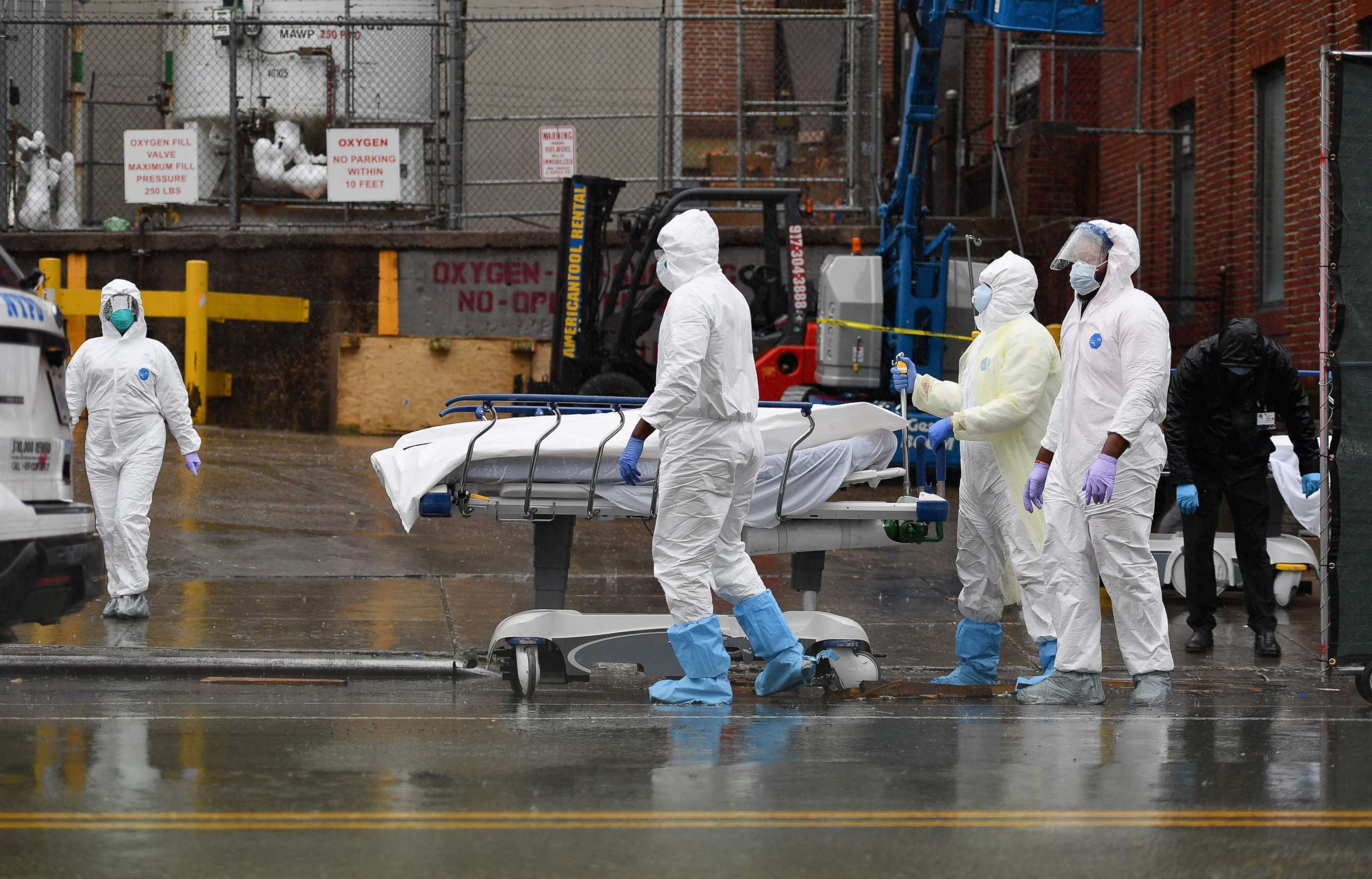
In this file photo taken on April 09, 2020, medical personnel move a deceased patient to a refrigerated truck serving as a makeshift morgue at The Brooklyn Hospital Center in New York City.
Angela Weiss/AFP via Getty Images
A total of 10,257,825 people in the United States have been diagnosed with COVID-19 since the pandemic began, and at least 239,683 of them have died, according to Johns Hopkins. The cases include people from all 50 U.S. states, Washington, D.C. and other U.S. territories as well as repatriated citizens.
Much of the country was under lockdown by the end of March as the first wave of pandemic hit. By May 20, all U.S. states had begun lifting stay-at-home orders and other restrictions put in place to curb the spread of the novel coronavirus. The day-to-day increase in the country's cases then hovered around 20,000 for a couple of weeks before shooting back up and crossing 100,000 for the first time on Nov. 4.
Nov 11, 2020, 10:46 PM EST
Pfizer vaccine temperature requirements 'greatest drug distribution challenge' yet, experts say
The freezers needed to properly store Pfizer's vaccine at around minus 70 degrees Celsius are "almost like unicorns in health care -- they're far and hard to find," Soumi Saha, senior director of pharmacy consulting company Premier, Inc., told ABCNL.
"[It's] the coldest that any vaccine or any drug has ever been required to be stored at," Saha said. "And so this is going to be the greatest drug distribution challenge that our country has ever faced because of the unique circumstances around the temperature requirement."
Keeping Pfizer's vaccine stable when distributing it in rural communities might pose another challenge, according to Azra Behlim, senior director of pharmacy sourcing and program services at Vizient.
"That is going to be a lot more difficult, because now we need to find a way to maintain that temperature while we are driving it out 20 or 50 miles in order to do an inoculation," Behlim told ABCNL.
Earlier this week, Pfizer and partner Biotech announced that their vaccine was "found to be more than 90% effective in preventing COVID-19" based on an early analysis that included 94 confirmed cases of COVID-19 in trial participants. More safety data is needed prior to authorization.
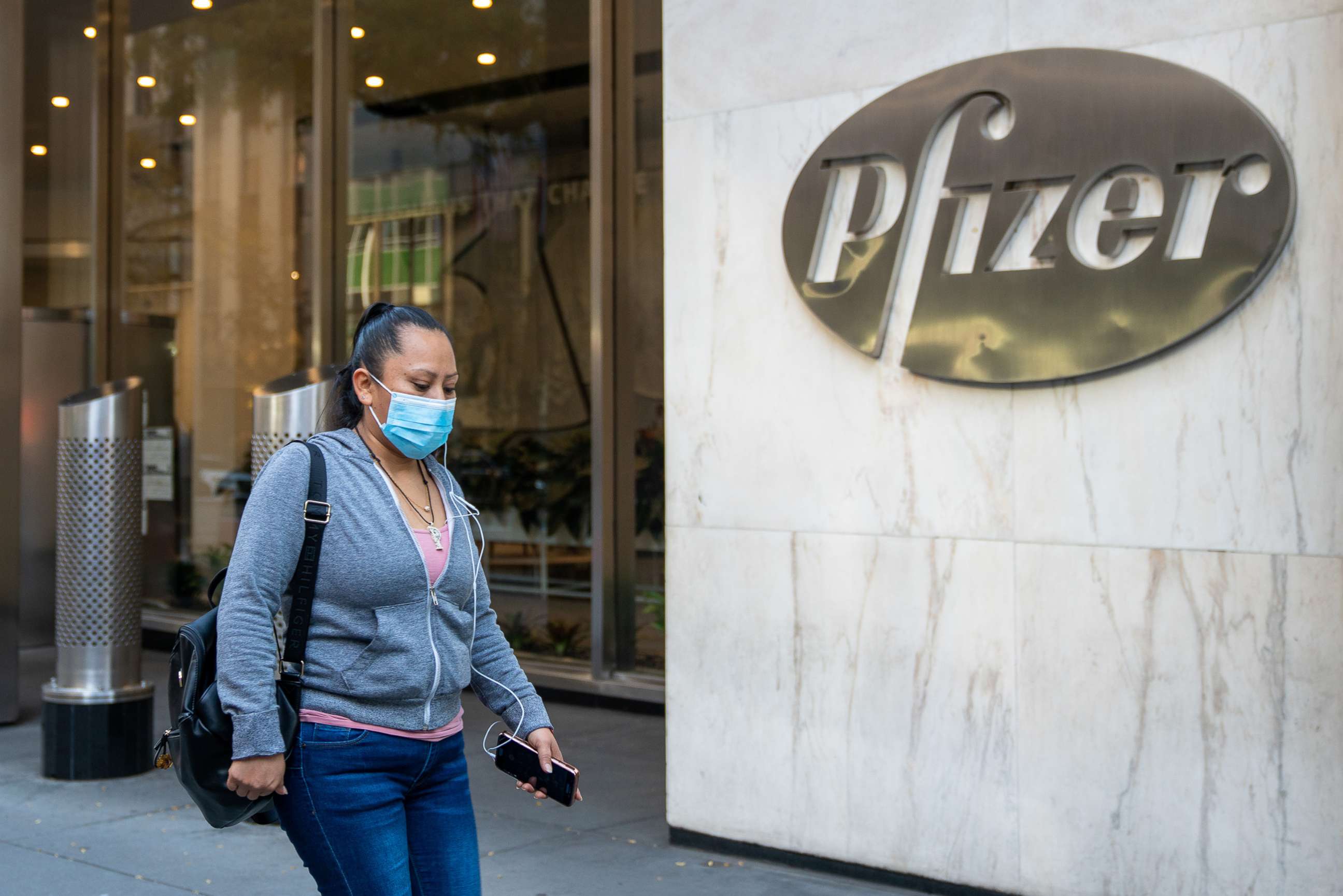
People walk by the Pfizer headquarters, Nov. 9, 2020, in New York. Pharmaceutical company Pfizer announced positive early results on its COVID-19 vaccine trial and has proven to be 90% effective in preventing infection of the virus.
David Dee Delgado/Getty Images
Pfizer has committed to produce globally up to 50 million vaccine doses in 2020 and up to 1.3 billion doses in 2021.
The company will distribute vaccine doses in special temperature-controlled thermal boxes packed with dry ice. Most will go from its Kalamazoo, Michigan, site directly to places where the vaccines are needed.
Upon reaching their destination, the doses can be repacked with dry ice and stored for up to 15 days, stored in normal refrigerators for up to five days or kept in ultra-low-temperature freezers for up to six months. These freezers are typically only available at large medical centers.
ABC News' Sony Salzman, Victor Ordonez and Layne Winn