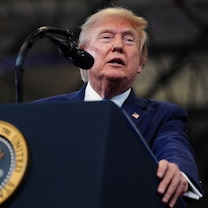
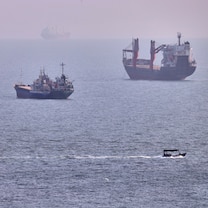
President Donald Trump announced "major combat operations" against Iran on Feb. 28, with massive joint U.S.-Israeli strikes targeting military and government sites.
Trump set a deadline for Iran to fully reopen the Strait of Hormuz or face broad strikes on its critical infrastructure. Hours before the deadline expired, Trump said he had agreed to suspend planned bombing for two weeks if Iran agreed to reopen the Strait of Hormuz.
Iranian Foreign Minister Abbas Araghchi then said that "safe passage through the Strait of Hormuz will be possible via coordination with Iran's Armed Forces and with due consideration of technical limitations."
Israeli Prime Minister Benjamin Netanyahu said he supported the ceasefire with Iran, but that Lebanon -- where intense Israeli strikes continued -- was not covered by the agreement, despite Iranian protests.
6 people injured amid attacks on Kuwait, health ministry says
Six people were injured in the northwest of Kuwait by "projectiles and shrapnel falling in a residential area" amid ongoing Iranian attacks, the Kuwait Health Ministry said on Monday.
A spokesperson for the Iranian military said on Monday morning that Iran had targeted U.S. military forces in Bubiyan, in northwest Kuwait.
-ABC News' Victoria Beaule
Apr 06, 2026, 6:36 AM EDT
Iran won't accept ceasefire without guarantees, Pakistani official says
Iran will not accept a ceasefire without "suitable guarantees," a Pakistani security official told ABC News on Monday.
"Any process for a ceasefire without suitable guarantees and assurances would be unacceptable to Iran," the official said, responding to reports that mediators are pushing for a ceasefire to halt the U.S.-Israel war against Iran.
-ABC News' Habibullah Khan and Somayeh Malekian
Apr 06, 2026, 6:13 AM EDT
US 15-point peace plan 'not acceptable,' Iranian official says
Iranian Foreign Ministry spokesperson Esmaeil Baghaei said on Monday that a 15-point peace plan proposed by the U.S. to end the current conflict is unacceptable to Tehran.
Answering a question from the state-run news agency IRNA about reports of a new ceasefire plan during his weekly presser, Baghaei said, "A few days ago, they put forward proposals through intermediaries, and the 15-point U.S. plan was reflected through Pakistan and some other friendly countries."
Iran's Foreign Ministry spokesperson Esmaeil Baghaei speaks during an interview in Tehran, Iran, pn April 5, 2026.
Majid-asgaripour/via Reuters
"Right then we stated that such proposals are both extremely ambitious, unusual and illogical and not acceptable to us in any way," he said.
"Regardless of that proposal, we prepared the set of demands that we had and have based on our own interests and our own considerations," Baghaei said.
-ABC News' Somayeh Malekian
Apr 06, 2026, 5:40 AM EDT
IRGC Navy says Strait of Hormuz will 'never return to its former state'
The Islamic Revolutionary Guard Corps Naval Command said in a post to X overnight that the Strait of Hormuz "will never return to its former state, especially for America and Israel."
"The navy of the IRGC is in the process of completing the operational preparations for the announced plan of Iran's officials for the new order in the Persian Gulf," the statement said.
Gas and Diesel prices are displayed at a Valero gas station on April 02, 2026 in San Marcos, Texas.
Brandon Bell/Getty Images
-ABC News' Joe Simonetti, Jordana Miller and Somayeh Malekian