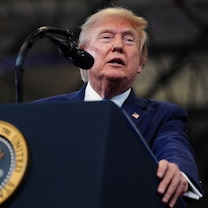
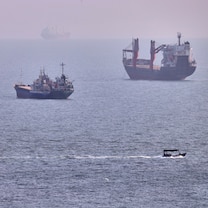
President Trump says US Navy will begin blockade of Strait of Hormuz

The U.S. and Iran failed to reach a peace deal after 21 hours of negotiations.

Last Updated: April 12, 2026, 10:22 PM EDT

President Donald Trump announced "major combat operations" against Iran on Feb. 28, with massive joint U.S.-Israeli strikes targeting military and government sites.

Trump set a deadline for Iran to fully reopen the Strait of Hormuz or face broad strikes on its critical infrastructure. Hours before the deadline expired, Trump said he had agreed to suspend planned bombing for two weeks if Iran agreed to reopen the Strait of Hormuz.

Iranian Foreign Minister Abbas Araghchi then said that "safe passage through the Strait of Hormuz will be possible via coordination with Iran's Armed Forces and with due consideration of technical limitations."

Israeli Prime Minister Benjamin Netanyahu said he supported the ceasefire with Iran, but that Lebanon -- where intense Israeli strikes continued -- was not covered by the agreement, despite Iranian protests.

Apr 06, 2026, 12:50 PM EDT

Trump says Iran 'got a little bit lucky' shooting down US jets

When asked about the apparent incongruency between his repeated claims that Iran had no anti-aircraft equipment and the downing of two U.S. jets, President Donald Trump said Iran “got a little bit lucky.”

“You know what? When you do thousands and thousands of flights and you have one plane shot down and not mortally, the two pilots got out, they got a little bit lucky,” Trump said.

An image released on April 5, 2026, and obtained from social media appears to show wreckage of an American aircraft and a helicopter rotor in Isfahan, Iran.
Reuters

The president was pressed on why the U.S. remains at war when he has repeatedly said Iran has been “obliterated.” While continuing to claim that Iran is unable to fight back, Trump also said they have “some” missiles and drones left.

"It’s a big country. They can't fight back. They have no capability. I mean, they'll have -- they have some missiles left. They have some drones left, but essentially they have no capability," he said. "They had a lucky shot with an airplane, but we got them back out."

-ABC NewsEmily Chang, Justin Gomez and Fritz Farrow

Apr 06, 2026, 12:32 PM EDT

Trump says Americans against war with Iran are 'foolish'

President Donald Trump said at the White House Easter Egg Roll on Monday that Americans against the war with Iran are “foolish,” saying the conflict is “about one thing: Iran cannot have a nuclear weapon.”

“We are obliterating their country. And I hate to do it, but we’re obliterating,” he said.

Trump said if he had his “choice,” he’d “take the oil.”

“Because it’s there for the taking -- there’s not a thing they can do about it,” Trump said. “Unfortunately, the American people would like to see us come home. If it were up to me, I’d take the oil, I’d keep the oil, I’d make plenty of money. And I’d also take care of the people of Iran.”

“If it were up to me I’d like to keep the oil, I just don’t think the people of the United States would really understand,” he added.

President Donald Trump took questions from reporters during the Easter Egg Roll event at the White House discussing the war with Iran.
9:12
Trump says Americans against war with Iran are 'foolish'President Donald Trump took questions from reporters during the Easter Egg Roll event at the White House discussing the war with Iran.
ABCNews.com
Apr 06, 2026, 11:05 AM EDT

Reported 45-day ceasefire 'one of many ideas,' White House official says

Asked about reports of a draft proposal that includes a 45-day ceasefire and reopening of the Strait of Hormuz, a White House official told ABC News on Monday, "This is one of many ideas, and POTUS has not signed off on it. Operation Epic Fury continues. President Trump will speak more at 1 p.m."

A U.S. official and another source familiar with the negotiations told ABC News later on Monday that the draft of the deal on the table calls for a 45-day ceasefire, during which a permanent end to the war could be negotiated.

A man inspects the damage to cars and an apartment building struck by an Iranian missile in Ramat Gan, Israel, April 6, 2026.
Oded Balilty/AP

While the White House has already said that President Donald Trump has not committed to anything, the administration’s key demands call for Iran to give up what the regime views as its main points of leverage: control over the Strait of Hormuz and its stockpile of highly enriched uranium. So far, Iran has shown little to no flexibility on those terms, both sources said.

The sources added that mediators are attempting to see if confidence-building measures might bring both sides closer to an agreement, but they are working on a very tight timeframe as Trump’s Tuesday deadline approaches.

Mediators have floated the idea that perhaps access to the Strait of Hormuz and the elimination of Iran’s uranium stockpile could be fully resolved after ceasefire is reached. The U.S. official said it appeared highly unlikely the Trump administration could be convinced to accept those terms -- particularly concerning the Strait of Hormuz.

Iran has signaled that it will not accept the mediators’ proposal as it stands, and submitted its own 10-point plan in response to the draft ceasefire agreement. U.S. officials describe Iran’s counteroffer as maximalist and not constructive to negotiations. -ABC News' Shannon Kingston and Justin Gomez

Apr 06, 2026, 10:53 AM EDT

Israel strikes Tehran-area airports

The Israeli military says it attacked three airports in the Tehran area on Monday in a "large-scale wave of strikes aimed at degrading the Iranian Air Force."

-ABC News’ Jordana Miller

Sponsored Content by Taboola