President Trump says US Navy will begin blockade of Strait of Hormuz

The U.S. and Iran failed to reach a peace deal after 21 hours of negotiations.

Last Updated: April 12, 2026, 10:22 PM EDT

President Donald Trump announced "major combat operations" against Iran on Feb. 28, with massive joint U.S.-Israeli strikes targeting military and government sites.

Trump set a deadline for Iran to fully reopen the Strait of Hormuz or face broad strikes on its critical infrastructure. Hours before the deadline expired, Trump said he had agreed to suspend planned bombing for two weeks if Iran agreed to reopen the Strait of Hormuz.

Iranian Foreign Minister Abbas Araghchi then said that "safe passage through the Strait of Hormuz will be possible via coordination with Iran's Armed Forces and with due consideration of technical limitations."

Israeli Prime Minister Benjamin Netanyahu said he supported the ceasefire with Iran, but that Lebanon -- where intense Israeli strikes continued -- was not covered by the agreement, despite Iranian protests.

Apr 08, 2026, 8:58 AM EDT

Strait of Hormuz is open, Hegseth and Caine say

Secretary of Defense Pete Hegseth and Gen. Dan Caine, the chairman of the Joint Chiefs of Staff, told reporters that the Strait of Hormuz has reopened.

"The strait is open," Hegseth said.

Hegseth said ships “will be sailing” through Hormuz.

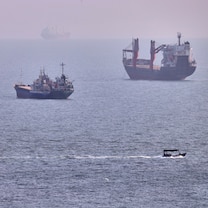
Oil tankers and cargo ships line up in the Strait of Hormuz as seen from Khor Fakkan, United Arab Emirates, March 11, 2026.
Altaf Qadri/AP

“It's time for the rest of the world to step up and ensure that that stays open, after President Trump and the War Department brought Iran to the place where they are voluntarily opening it right now, as was announced last night," Hegseth said.

Apr 08, 2026, 8:57 AM EDT

Strikes on Hezbollah will continue, IDF says

Israel will continue to target Hezbollah in Lebanon using "every operational opportunity," Lt. Gen. Eyal Zamir, the Chief of General Staff of the Israel Defense Forces said in a statement Wednesday.

"We will continue striking the Hezbollah terror organization and will utilize every operational opportunity. We will not compromise the security of the residents of northern Israel," Zamir said.

Apr 08, 2026, 8:40 AM EDT

Iran must hand over enriched uranium or US reserves right to remove it, Hegseth says

Secretary of Defense Pete Hegseth said the U.S. is monitoring Iran's enriched uranium and that it being handed over is a "non-negotiable" for the U.S.

"We know exactly what they have, and they know that, and they will either give it to us, which the president has laid out, will give it to us voluntarily ... or if we have to do something else ourselves, like we did in Midnight Hammer or something like that, we reserve that opportunity," Hegseth said.

Secretary of Defense Pete Hegseth speaks during a press briefing at the Pentagon in Washington, April 8, 2026.
Mandel Ngan/AFP via Getty Images

"What the new Iranian regime knows is they'll never have a nuclear weapon or the capability to get a path to one," Hegseth said.

Apr 08, 2026, 8:29 AM EDT

US achieved all 3 military objectives assigned by Trump

Gen. Dan Caine, the chairman of the Joint Chiefs of Staff, welcomed the ceasefire agreement but said the U.S. remains ready to continue combat operations "if called upon."

Caine honored the lives of the 13 service members killed in the operation before outlining U.S. achievements in Iran.

Secretary of War Pete Hegseth and Chairman of the Joint Chiefs of Staff Air Force General Dan Caine arrive for a press briefing at the Pentagon, April 8, 2026 in Arlington, Virginia.
Andrew Harnik/Getty Images

When ordering the beginning of the strikes, President Donald Trump set "three distinct military objectives: destroy ballistic missile and drawing drone capabilities, destroy the Iranian Navy and destroy their defense industrial base to ensure that Iran can reconstitute the ability to project power outside their borders."

Caine said the U.S. achieved the objectives.

Sponsored Content by Taboola