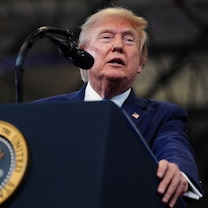
President Trump says US Navy will begin blockade of Strait of Hormuz

The U.S. and Iran failed to reach a peace deal after 21 hours of negotiations.

Last Updated: April 12, 2026, 10:22 PM EDT

President Donald Trump announced "major combat operations" against Iran on Feb. 28, with massive joint U.S.-Israeli strikes targeting military and government sites.

Trump set a deadline for Iran to fully reopen the Strait of Hormuz or face broad strikes on its critical infrastructure. Hours before the deadline expired, Trump said he had agreed to suspend planned bombing for two weeks if Iran agreed to reopen the Strait of Hormuz.

Iranian Foreign Minister Abbas Araghchi then said that "safe passage through the Strait of Hormuz will be possible via coordination with Iran's Armed Forces and with due consideration of technical limitations."

Israeli Prime Minister Benjamin Netanyahu said he supported the ceasefire with Iran, but that Lebanon -- where intense Israeli strikes continued -- was not covered by the agreement, despite Iranian protests.

Apr 09, 2026, 7:22 AM EDT

Pakistan, EU officials condemn ceasefire 'violations' in Lebanon

Pakistani Foreign Minister Ishaq Dar and European Union foreign affairs chief Kaja Kallas both "expressed concern over serious violations of the ceasefire in Lebanon" in a phone conversation on Thursday, according to a readout from the Pakistani Foreign Ministry.

The two officials emphasized the need for the "full implementation of the temporary ceasefire in the Middle East," the readout said.

In a post to her own X channel, Kallas said that Hezbollah "dragged Lebanon into the war, but Israel's right to defend itself does not justify inflicting such massive destruction."

"Israeli actions are putting the U.S.-Iran ceasefire under severe strain. The Iran truce should extend to Lebanon. Hezbollah must disarm. The EU supports Lebanon's efforts to disarm Hezbollah," Kallas added.

A man checks the damage at the site of an Israeli airstrike the day before that targeted a neighborhood in the southern Lebanese coastal city of Tyre on April 9, 2026.
Ibrahim Amro/AFP via Getty Images

Israeli Prime Minister Benjamin Netanyahu and Vice President JD Vance have said Lebanon was not included in the two-week ceasefire agreement announced on Tuesday.

Pakistani Prime Minister Shehbaz Sharif, though, said in his announcement of the truce that Lebanon was covered.

Iranian officials and state media have likewise suggested that Lebanon is part of the ceasefire deal and have warned that continued Israeli action there could prompt Iranian retaliation.

Apr 09, 2026, 6:55 AM EDT

4 Lebanese soldiers killed by Israeli strikes, army says

The Lebanese Armed Forces announced on Thursday that four of its troops were killed by Israeli airstrikes on Wednesday.

Two soldiers were killed in the eastern Baalbek region, one in the southeastern region of Hermel and one in the coastal region of Sidon, the army said in a statement.

Smoke rises from the site of an Israeli airstrike that targeted an area in the southern Lebanese city of Sidon on April 8, 2026.
Mahmoud Zayyat/AFP via Getty Images
Apr 09, 2026, 6:46 AM EDT

Iranians mark 40 days since Khamenei assassination

Thursday marked 40 days since the assassination of Iran's Supreme Leader Ali Khamenei and the start of the U.S.-Israeli war against Iran on Feb. 28.

Thousands of regime supporters across Tehran and elsewhere in Iran gathered, carrying Iranian flags and some carrying portraits of Khamenei.

His son, Mojtaba Khamenei, the country's new supreme leader, has not been seen in public since the start of the war.

A banner with an image of late Supreme Leader of Iran Ayatollah Ali Khamenei during a ceremony marking 40 days since he was killed in Israeli and U.S. strikes, in Tehran, Iran, on April 9, 2026.
Majid Asgaripour/via Reuters

-ABC News' Joe Simonetti

Apr 09, 2026, 6:17 AM EDT

Iranian media publishes Strait of Hormuz routes to avoid 'sea mines'

Iranian media issued a chart outlining "alternative" traffic routes in the Strait of Hormuz to protect vessels from what it said were "possible collisions with sea mines."

The chart was widely published on Wednesday along with a statement detailing the alternative routes by Iran's semi-official news agencies, including those close to the Islamic Revolutionary Guard Corps such as Fars and Tasnim.

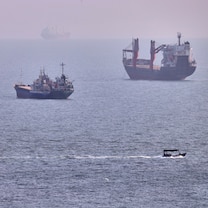
Boats sit off the coast in the Strait of Hormuz, as pictured from Musandam Governorate, Oman, on April 8, 2026.
Stringer/Reuters

According to the statement, all vessels intending to transit the Strait of Hormuz "must coordinate with the IRGC Navy" and use alternative routes in order "to observe maritime safety principles and avoid potential collisions with sea mines."

The statement and chart were initially attributed to the Iranian Ports and Maritime Organization. However, in later reports, news agencies close to the IRGC -- including Fars and Tasnim -- attributed them to the IRGC Navy.

The alternative routes pass close to Iran's coastline in the northern part of the Strait of Hormuz, passing either side of Larak island.

-ABC News' Somayeh Malekian and Victoria Beaule

Sponsored Content by Taboola