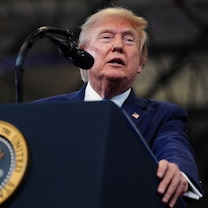
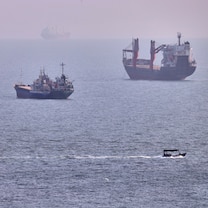
President Trump says US Navy will begin blockade of Strait of Hormuz

The U.S. and Iran failed to reach a peace deal after 21 hours of negotiations.

Last Updated: April 12, 2026, 10:22 PM EDT

President Donald Trump announced "major combat operations" against Iran on Feb. 28, with massive joint U.S.-Israeli strikes targeting military and government sites.

Trump set a deadline for Iran to fully reopen the Strait of Hormuz or face broad strikes on its critical infrastructure. Hours before the deadline expired, Trump said he had agreed to suspend planned bombing for two weeks if Iran agreed to reopen the Strait of Hormuz.

Iranian Foreign Minister Abbas Araghchi then said that "safe passage through the Strait of Hormuz will be possible via coordination with Iran's Armed Forces and with due consideration of technical limitations."

Israeli Prime Minister Benjamin Netanyahu said he supported the ceasefire with Iran, but that Lebanon -- where intense Israeli strikes continued -- was not covered by the agreement, despite Iranian protests.

Apr 10, 2026, 8:51 AM EDT

Vance heads to Islamabad for Iran talks

Just before taking off to Islamabad, Pakistan, for negotiation talks with Iran, Vice President JD Vance told reporters he expects “positive” discussions.

"We're looking forward to the negotiation. I think it's going to be positive,” Vance told reporters before boarding Air Force Two.

Despite the optimistic outlook, the vice president delivered a warning that the U.S. will not be “receptive” if the Iranians try to “play us.”

“We'll foresee, as the President of the United States said, if the Iranians are willing to negotiate in good faith, we're certainly willing to extend the open hand. If they're going to try to play us, then they're going to find that the negotiating team is not that receptive,” he said.

Vice President JD Vance speaks to the press before boarding Air Force Two, Friday, April 10, 2026, at Joint Base Andrews, Md., for expected departure to Pakistan, for talks on Iran.
Jacquelyn Martin/AP

Vance added that President Donald Trump has given the American negotiating team “some pretty clear guidelines” that he intends to see through.

Vance will be leading the U.S. delegation in upcoming negotiations, which are slated to begin Saturday morning.

-ABC News' Emily Chang

Apr 10, 2026, 8:17 AM EDT

Iran says 10-point plan to be basis for talks, rejects ceasefire enabling rearmament

Iran’s Deputy Foreign Minister Majid Takht-Ravanchi said Friday that Tehran’s proposed 10-point plan will be the basis for the negotiations, according to the Islamic Republic News Agency.

“We do not want a ceasefire that allows the aggressor enemy to rearm and carry out further attacks,” Takht-Ravanchi told ambassadors and heads of foreign diplomatic missions.

"The Islamic Republic of Iran always welcomes diplomacy and dialogue, but not a dialogue that is based on false information with the aim of deception and laying the groundwork for another military aggression against Iran," the statement said.

-ABC News' Somayeh Malekian

Apr 10, 2026, 6:27 AM EDT

Iran says no airstrikes launched by Iranian forces since ceasefire began

The Islamic Revolutionary Guard Corps (IRGC) said in a statement on Friday that Iran’s armed forces have not carried out any airstrikes against other countries since the ceasefire began.

"The Armed Forces of the Islamic Republic of Iran have absolutely not launched any projectiles toward any country during the ceasefire hours up to this moment," the statement said.

The IRGC added that if Iran were to strike any target, it would “courageously announce it in an official statement.”

An Iranian man waves Iran's national flag in front of a large billboard showing a portrait of the late Iranian Supreme Leader Ayatollah Ali Khamenei at Valiasr Square in Tehran, Iran, April 10, 2026.
Abedin Taherkenareh/EPA/Shutterstock

-ABC News' Somayeh Malekian

Apr 10, 2026, 5:43 AM EDT

Ukrainian interceptors destroyed Iranian drones in 'several' countries, Zelenskyy says

Ukrainian President Volodymyr Zelenskyy confirmed that Ukrainian interceptor drones have been used in "several" countries in the Middle East to destroy Iranian Shahed one-way attack drones.

In a post on X, Zelenskyy said the work carried out in Gulf states by Ukrainian interceptor drone and electronic warfare teams was "about building a modern air defense system that can actually work."

The Ukrainian leader said his country was able to share its own experience in anti-drone defense to "quickly advise" on how to make air defense systems stronger.

Zelenskyy also noted that faster-type Iranian drones which are powered by jet engines were also intercepted and said it was only a matter of time "before we begin mass production of interceptors that will destroy drones with jet engines."

-ABC News' Tom Soufi Burridge

Sponsored Content by Taboola