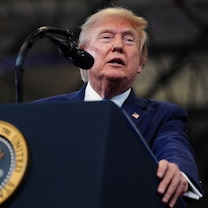
President Donald Trump announced "major combat operations" against Iran on Feb. 28, with massive joint U.S.-Israeli strikes targeting military and government sites.
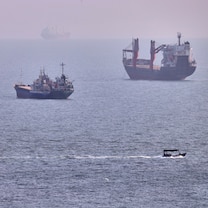
Trump set a deadline for Iran to fully reopen the Strait of Hormuz or face broad strikes on its critical infrastructure. Hours before the deadline expired, Trump said he had agreed to suspend planned bombing for two weeks if Iran agreed to reopen the Strait of Hormuz.
Iranian Foreign Minister Abbas Araghchi then said that "safe passage through the Strait of Hormuz will be possible via coordination with Iran's Armed Forces and with due consideration of technical limitations."
Israeli Prime Minister Benjamin Netanyahu said he supported the ceasefire with Iran, but that Lebanon -- where intense Israeli strikes continued -- was not covered by the agreement, despite Iranian protests.
Release of blocked Iranian assets must come before talks, Ghalibaf says
The speaker of Iran's parliament, Mohammad Bagher Ghalibaf, said that "the release of Iran’s blocked assets" has been one of the "measures mutually agreed upon between the parties," but is yet to be implemented prior to the commencement of negotiations, in a post on X on Friday.
He said a ceasefire in Lebanon is another measure that must be implemented before the talks.
-ABC News' Somayeh Malekian
Apr 10, 2026, 10:57 AM EDT
Iran warns of 'crushing response' if Israel continues strikes on Lebanon
Israel will receive a “crushing and painful response” if it continues its attacks on Lebanon, the Khatam Al-Anbiya Central Headquarters of Iran’s armed forces warned in a statement on Friday.
Iran will take the management of the Strait of Hormuz “to a new stage” and “maintain the initiative to dominate the strait," the Khatam Al-Anbiya Central Headquarters added.
"We will not give up our legitimate rights in any way," the statement said.
A digger clears the rubble of a building in Beirut's Hay al-Selloum neighbourhood, that was targetted in an Israeli strike earlier this week, April 10, 2026.
Fadel Itani/AFP via Getty Images
Apr 10, 2026, 10:34 AM EDT
Hezbollah’s leader warns Lebanese officials against making 'free concessions'
Hezbollah Secretary General Naim Qassem said in a statement Friday that the "resistance" would not accept a return to the previous status quo, adding that the group would continue fighting “until the last breath."
Listing Israeli attacks across several areas in Lebanon on Wednesday, Qassem said Israel had failed to stop Hezbollah’s missiles and warned Lebanese officials against making “free concessions” in negotiations.
A man checks a destroyed building, that was struck in an Israeli airstrike on Wednesday, in Beirut, Lebanon, April 10, 2026.
Emilio Morenatti/AP
"We will not accept a return to the previous situation, and we call on officials to stop making free concessions," he said.
Apr 10, 2026, 8:51 AM EDT
Vance heads to Islamabad for Iran talks
Just before taking off to Islamabad, Pakistan, for negotiation talks with Iran, Vice President JD Vance told reporters he expects “positive” discussions.
"We're looking forward to the negotiation. I think it's going to be positive,” Vance told reporters before boarding Air Force Two.
Despite the optimistic outlook, the vice president delivered a warning that the U.S. will not be “receptive” if the Iranians try to “play us.”
“We'll foresee, as the President of the United States said, if the Iranians are willing to negotiate in good faith, we're certainly willing to extend the open hand. If they're going to try to play us, then they're going to find that the negotiating team is not that receptive,” he said.
Vice President JD Vance speaks to the press before boarding Air Force Two, Friday, April 10, 2026, at Joint Base Andrews, Md., for expected departure to Pakistan, for talks on Iran.
Jacquelyn Martin/AP
Vance added that President Donald Trump has given the American negotiating team “some pretty clear guidelines” that he intends to see through.
Vance will be leading the U.S. delegation in upcoming negotiations, which are slated to begin Saturday morning.