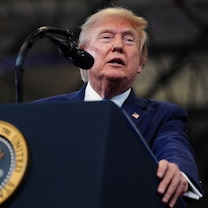
President Donald Trump announced "major combat operations" against Iran on Feb. 28, with massive joint U.S.-Israeli strikes targeting military, government and infrastructure sites.
Following the announcement of a two-week ceasefire, initial U.S.-Iran talks in Pakistan earlier this month failed to reach a peace deal.
Trump later announced the open-ended extension of the ceasefire and the continuation of the blockade until Iran's proposal is submitted and discussions are concluded "one way or the other."
Senate fails to advance Iran war powers resolution for 5th time
The Senate rejected an Iran war powers resolution for the fifth time on Wednesday.
The resolution, which needed 51 votes to advance, failed by a vote of 46-51. As with previous votes, Sen. Rand Paul was the lone Republican to vote for the resolution and Sen. John Fetterman was the only Democrat to vote against it.
Democrats have vowed to continually bring up war power resolutions that direct the "removal of United States Armed Forces from hostilities within or against the Islamic Republic of Iran that have not been authorized by Congress" as long as the conflict continues.
-ABC News' Allison Pecorin
Apr 22, 2026, 4:16 PM EDT
Trump has 'not set a deadline' for Iran talks, proposal, White House says
White House press secretary Karoline Leavitt said there is no set deadline for the ceasefire with Iran that was extended by President Donald Trump on Tuesday and that any reports that Trump had set a three to five day timeline for a unified peace proposal from Iran are "not true."
"I'm not going to set a timetable for the president. He has not done that, and I won't. I know there's been some anonymous, sourced reporting that there was maybe a three to five day deadline. That is not true. The president has not set a deadline himself," Leavitt told reporters at the White House on Wednesday.
Leavitt placed blame on Iran over the fact that a peace deal has not been finalized but also suggested that Trump has given Iranian leaders flexibility on coming up with a proposal.
"The president chose to extend the ceasefire because it's Iran who needs to get their acts together," she said.
U.S. Central Command said 29 ships have been turned back or returned to Iranian ports as part of the U.S. blockade.
CENTCOM also pushed back on reports that other ships were able to evade the blockade and called those reports inaccurate. But, acknowledge that one ship, the Dorena, is currently under escort by a U.S. Navy destroyer in the Indian Ocean "after previously attempting to violate the blockade."
That ship is included among the 29 turned around ships.
Apr 22, 2026, 1:49 PM EDT
Iran has 'thousands' of missiles and drones left
The Defense Intelligence Agency chief told lawmakers that Iran still has an enormous stockpile of munitions, even after the constant bombardment throughout the war until the ceasefire.
“Iran retains thousands of missiles and one-way attack UAVs that can threaten U.S. and partner forces throughout the region, despite degradations to its capabilities from both attrition and expenditure,” Marine Lt. Gen. James Adams, told lawmakers last week.
Remnants of an Iranian missile are pictured near the border between the Israeli-annexed Golan Heights and Syria, April 9, 2026.
Erik Marmor/Getty Images
He added that Iran’s conventional military remains hampered by aging equipment and limited training, likely pushing Tehran to lean even harder into asymmetric tactics. That includes the kind of low-cost drone threats now looming over the Strait of Hormuz, a reminder that Iran can still create outsized disruption through cheap tools.
Those tactics also include cyberattacks.
“Before the current conflict, Iran largely refrained from cyberattacks against the United States, except for a handful of low level disruptive attacks,” Adams said. “However, on 11 March, we observed Iran’s first destructive cyberattack against a U.S. company since 2014, when Iranian cyberattacks conducted a data-deletion attack against a U.S. medical company. Iran almost certainly will continue using cyberattack.”
Iranians walk past a poster of Iranian supreme leader Ayatollah Mojtaba Khamenei in a street in Tehran, Iran, April 22, 2026.
Abedin Taherkenareh/EPA/Shutterstock
Adams was likely referring to when an Iranian-linked group hacked Stryker, a Michigan-based medical company. The day after the cyber-attack, Stryker pushed out a statement urging its tools were safe, including the Mako Surgical Robot, a robotic arm that assists in joint replacement surgeries and the LIFEPAK 35, a life support monitor/defibrillator.
Earlier this month, the Cybersecurity and Infrastructure Security Agency warned that Iran-linked cyber groups had targeted systems tied to local municipalities, as well as water and energy networks. In an advisory, the agency said organizations across multiple critical infrastructure sectors had suffered disruptions through “malicious interactions with the project files” and the manipulation of data.
Iran’s defense budget last year was $16.8 billion, which is about 4.2% of its GDP, according to Adams.