President Donald Trump announced "major combat operations" against Iran on Feb. 28, with massive joint U.S.-Israeli strikes targeting military, government and infrastructure sites.
Following the announcement of a two-week ceasefire, initial U.S.-Iran talks in Pakistan in April failed to reach a peace deal.
Trump later announced the open-ended extension of the ceasefire and the continuation of a U.S. blockade until negotiations are concluded "one way or the other."
IDF strikes 40 alleged Hezbollah targets in south Lebanon
The Israel Defense Forces said in a statement on Wednesday that it struck at least 40 alleged Hezbollah targets in southern Lebanon across the previous 24 hours, as fighting there continues despite a ceasefire agreed between Israeli and Lebanese leaders last month.
IDF spokesperson Avichay Adraee issued new evacuation orders for six villages in southern Lebanon on Wednesday morning, warning of imminent Israeli strikes there.
Hezbollah continued to target Israeli forces operating in southern Lebanon on Tuesday and Wednesday, according to statements it released on Telegram detailing its latest attacks.
The IDF said Hezbollah launched "several rockets" toward Israeli positions in southern Lebanon on Wednesday morning.
An explosion erupts in the area of al-Housh following Israeli bombardment as seen from Tyre in southern Lebanon on May 12, 2026.
Kawnat Haju/AFP via Getty Images
3:30 AM EDT
US 'dishonesty' undermining talks, Araghchi says
Iranian Foreign Minister Abbas Araghchi claimed on Tuesday that "America's lack of goodwill and dishonesty" is to blame for the failure of peace talks to date, as quoted in a readout by the semi-official ISNA agency on Tuesday.
During a meeting with the Norwegian Deputy Foreign Minister Andreas Kravik in Tehran, Araghchi said the U.S. negotiating team had demonstrated an "overbearing approach, threatening and provocative rhetoric" in peace talks.
Araghchi also accused the U.S. of "repeated violations of the ceasefire with the continued blockade of Iranian seaports."
Iran, he said, is consulting on new regulations "related to the Strait of Hormuz in accordance with international law."
Iranian Foreign Minister Abbas Araghchi appears on ABC News' "This Week" on March 1, 2026
ABC News
-ABC News' Will Gretsky
3:14 AM EDT
Trump says US doesn't need China's help on Iran
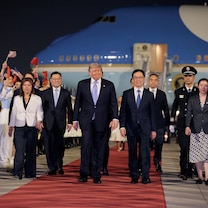
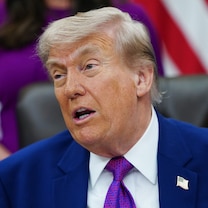
Ahead of his trip to China, President Donald Trump gave conflicting answers when asked on Tuesday if Beijing should intervene to help end the war with Iran.
"I don't think we need any help with Iran," he said at first. Minutes later, when Trump was asked if Chinese President Xi Jinping was the person who could revive the ceasefire, the president said he would like whatever help Xi can offer.
But, when pressed on Xi's possible help, Trump again said the U.S. did not need assistance. "They're defeated militarily, and they'll either do the right thing or we'll finish the job," Trump said.
President Donald Trump waves as he boards Air Force One, May 12, 2026 at Joint Base Andrews, Maryland.
Alex Wong/Getty Images
Moments later, Trump added that he "wouldn't say Iran" is one of the topics he plans to discuss with Xi because the U.S. has it "under control."
"We're either going to make a deal or they're going to be decimated, one way or the other," Trump said.
Trump again dismissed economic concerns related to the ongoing war, suggesting inflation would fall 1.5% after the war ends amid what he predicted would be a "gusher of oil."
"And one way the other, it's going to work out very well. Going to work out very well. I think you have so much oil, you're going to have a gusher of oil like you've never had before," Trump said, once again stressing that he thought oil prices would have risen higher.
"And as soon as this war is over, which will not be long, you're going to see oil prices drop, and you're going to see a stock market, which is already at the highest point in history, go through the roof. You're going to see the golden age of America, frankly, and you're seeing it now," Trump said.
Asked about the progress of negotiations with Tehran, Trump said, "Well, we're going to see what happens. We're only making a good deal."
"But I believe that one way or the other, it's going to be very good for the American people, and I think actually very good for the Iranian people," Trump said.
-ABC News' Emily T. Chang and Fritz Farrow
May 12, 2026, 9:44 AM EDT
Iran war has cost at least $29 billion, Pentagon official says
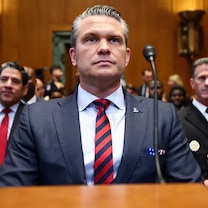
The Iran war is estimated to have cost $29 billion, acting Pentagon comptroller Jules W. Hurst III told lawmakers Tuesday morning during a House Appropriations hearing.
Two weeks ago, Hurst testified it was $25 billion, much of which was attributed to munitions costs.
Hurst said the updated number comes after accounting for, "replacement of equipment costs and also just general operational costs keep people in theater."
Rep. Pete Aguilar, D-Calif., asked Secretary of Defense Pete Hegseth when Congress would get a more detailed accounting for war costs.
“When it's relevant and required, we will share it,” Hegseth responded.