President Donald Trump announced "major combat operations" against Iran on Feb. 28, with massive joint U.S.-Israeli strikes targeting military and government sites.
After initial U.S.-Iran talks in Pakistan failed to reach a peace deal, Trump announced Sunday, April 19, that U.S. negotiators would head back to Islamabad Monday for a new round.
White House press secretary Karoline Leavitt said Vice President JD Vance would accompany special envoy Steve Witkoff and Jared Kushner, the president's son-in-law, to Islamabad for the talks.
Iran's continuing blockage of the Strait of Hormuz and their alleged refusal to abandon their nuclear program remain key sticking points in negotiations, according to Trump.
China assured US it would not send weapons to Iran, Hegseth says
Asked about reporting that there is U.S. intelligence indicating that China is preparing weapons shipments to Iran during the ceasefire, Defense Secretary said China has assured the U.S. this is not the case.
Secretary of Defense Pete Hegseth speaks during a briefing on the Iran war, at the Pentagon in Washington, April 16, 2026.
Alex Wong/Getty Images
"President Trump has a very strong and direct relationship with President Xi, and they've communicated on that, and China has assured us that that indeed is not going to happen," Hegseth said.
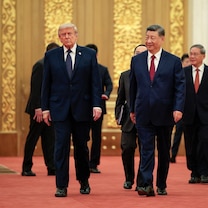
Trump and Xi are expected to meet in China in May, a trip that was delayed after the start of the U.S.-Israeli war with Iran.
Apr 16, 2026, 8:44 AM EDT
Iran has a 'high incentive' to remain in ceasefire despite degraded capabilities, Hegseth says
Despite Iranian leadership's command and control capabilities being "highly degraded," Iran has a "high incentive" to maintain in the ceasefire, Defense Secretary Pete Hegseth said in a press conference at the Pentagon Thursday.
Secretary of Defense Pete Hegseth speaks during a briefing on the Iran war, at the Pentagon in Washington, April 16, 2026.
Nathan Howard/Reuters
Chairman of the Joint Chiefs of Staff Gen. Dan Caine warned that during the ceasefire "the United States Joint Force remains postured and ready to resume major combat operations at literally a moment's notice."
Apr 16, 2026, 8:33 AM EDT
Caine warns ships away from trying to cross blockade line
Chairman of the Joint Chiefs of Staff Gen. Dan Caine described in detail on Thursday the current state of the U.S. blockade of Iranian ports, warning any ship away from trying to cross the blockade line.
"This blockade applies to all ships, regardless of nationality, heading into or from Iranian ports. The US action is a blockade of Iran's ports and coastline, not a blockade of the Strait of Hormuz," Caine said during a press conference at the Pentagon Thursday.
Chairman of the Joint Chiefs of Staff Gen. Dan Caine speaks as he displays a map showing the United States Navy's blockade of the Strait of Hormuz during a press briefing at the Pentagon on April 16, 2026 in Arlington, Virginia.
Alex Wong/Getty Images
Enforcement of blockade will be in in territorial seas and international waters, Caine said. Speaking in front of a map of the strait, Caine said that 13 ships had "made the wise choice" of turning around instead of attempting to traverse the waterway.
Chairman of the Joint Chiefs of Staff General Dan Caine displays a map showing the blockade line in the Strait of Hormuz during a briefing on the Iran war, at the Pentagon in Washington, April 16, 2026.
DoD
Caine said the U.S. would "actively pursue any Iranian flagged vessel or any vessel attempting to provide material support to Iran."
"This includes dark fleet vessels carrying Iranian oil," he added.
Apr 16, 2026, 8:22 AM EDT
Hegseth says US is 'reloading,' is 'locked and loaded' on critical infrastructure
U.S. Defense Secretary Pete Hegseth warned the Iranian regime that the U.S. would target "dual-use" critical infrastructure if the two sides fail to reach a deal war.
"We are reloading with more power than ever before, and better intelligence, even more importantly, better intelligence than ever before," Hegseth said. "As you expose yourself with your movement to our watchful eye, we are locked and loaded on your critical dual-use infrastructure, on your remaining power generation and on your energy industry."
U.S. Secretary of Defense Pete Hegseth and Chairman of the Joint Chiefs of Staff General Dan Caine hold a briefing on the Iran war, at the Pentagon in Washington, D.C., U.S., April 16, 2026.
Nathan Howard/Reuters
"We'd rather not have to do it, but we're ready to go at the command of our president and at the push of a button. This blockade -- which the chairman will detail this morning -- is the polite way that this can go," Hegseth said.