Highlights from Senate vote to confirm Ketanji Brown Jackson

The Senate voted 53-47 in a bipartisan vote on Jackson's nomination.

Last Updated: April 7, 2022, 5:29 PM EDT

Judge Ketanji Brown Jackson, the first Black woman nominated to the U.S. Supreme Court in its 233-year history, was confirmed by the Senate in a 53-47 vote Thursday.

She got three Republican votes, marking a bipartisan victory for President Joe Biden and his high court nominee.

Mar 21, 2022, 2:28 PM EDT

Confirmation hearings resume

After a 30-minute break, the Senate Judiciary Committee reconvened for confirmation hearings for Biden’s first nominee to the Supreme Court.

Seven more senators will deliver opening statements before the public hears from two introducers and then Jackson herself.
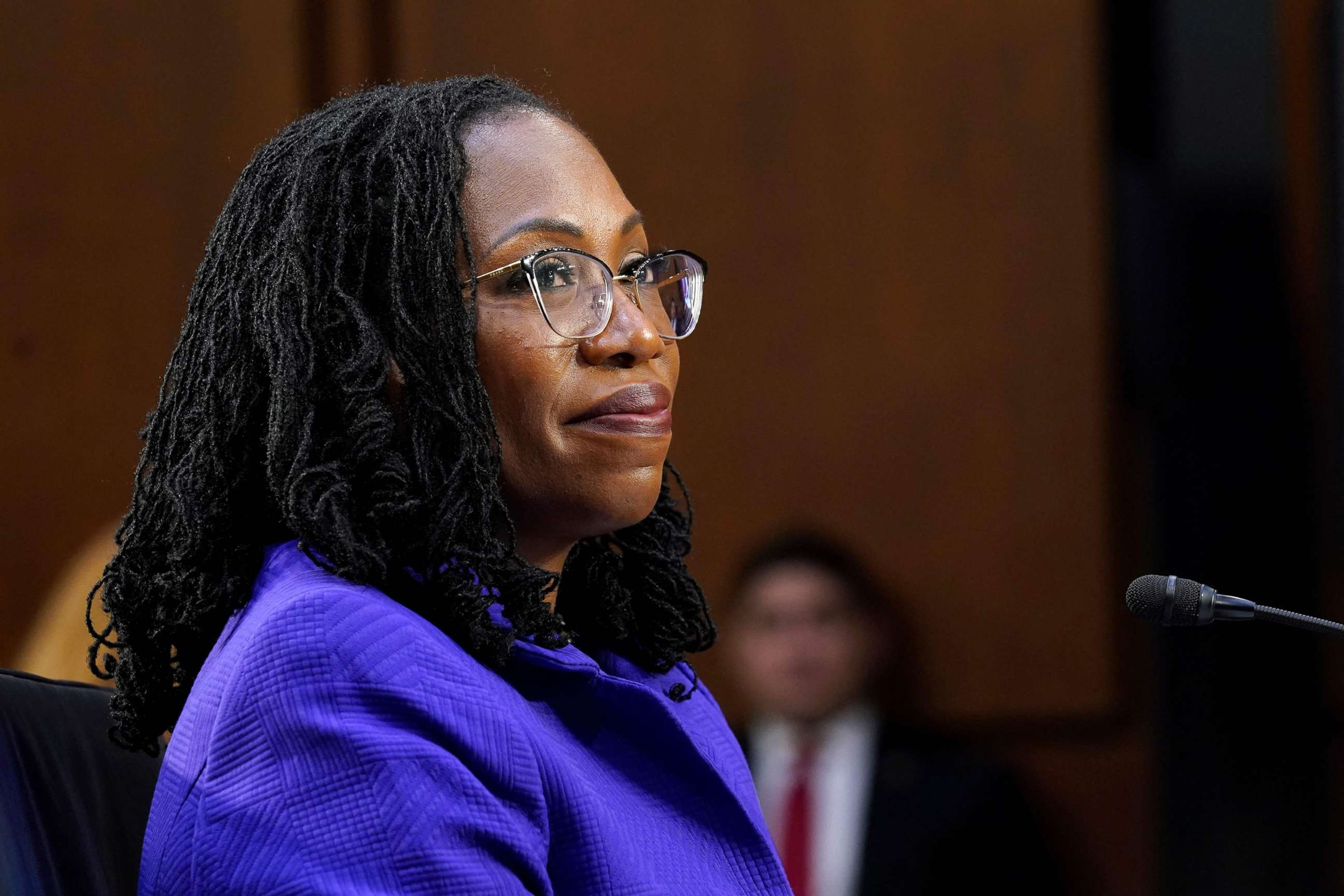
Supreme Court nominee Ketanji Brown Jackson listens during her Senate Judiciary Committee confirmation hearing on Capitol Hill in Washington, D.C, March 21, 2022.
J. Scott Applewhite/POOL/AFP via Getty Images

Democrats have continued to highlight the significance of the moment as Monday marks the first time the Senate has considered a Black woman for the nation’s highest court. They have also used their time to defend Biden’s nominee against GOP attacks that she’s "soft on crime," touting her ties to law enforcement and her endorsement from the fraternal order of police.

Several Republicans, meanwhile, have raised past grievances regarding Supreme Court Justice Brett Kavanaugh’s confirmation hearings, suggesting their nominee wasn’t treated fairly in 2018.

"We won’t try to turn this into a spectacle based on alleged process fouls," said Ranking Republican Sen. Chuck Grassley of Iowa. "On that front, we’re off to a good start."
Mar 21, 2022, 1:57 PM EDT

Hawley claims Jackson too lenient in child porn cases

In a sign the hearings could get contentious, Republican Sen. Josh Hawley of Missouri -- a former Supreme Court clerk for Chief Justice John Roberts and a potential presidential hopeful -- before the break launched straight into his concerns about Jackson’s sentencing record when it comes to child porn offenders.

While court records show Jackson did impose lighter sentences than federal guidelines suggested, Hawley's insinuation neglects critical context, including the fact that the senator himself has voted to confirm at least three federal judges who also engaged in the same practice, reports ABC News' Devin Dwyer.

Noting that the judge hasn't had a chance to answer questions and saying he isn't trying to "trap" her, Hawley referenced seven child pornography cases in which Jackson “handed down a lenient sentence that was below what the federal guidelines recommended and below what prosecutors requested.”

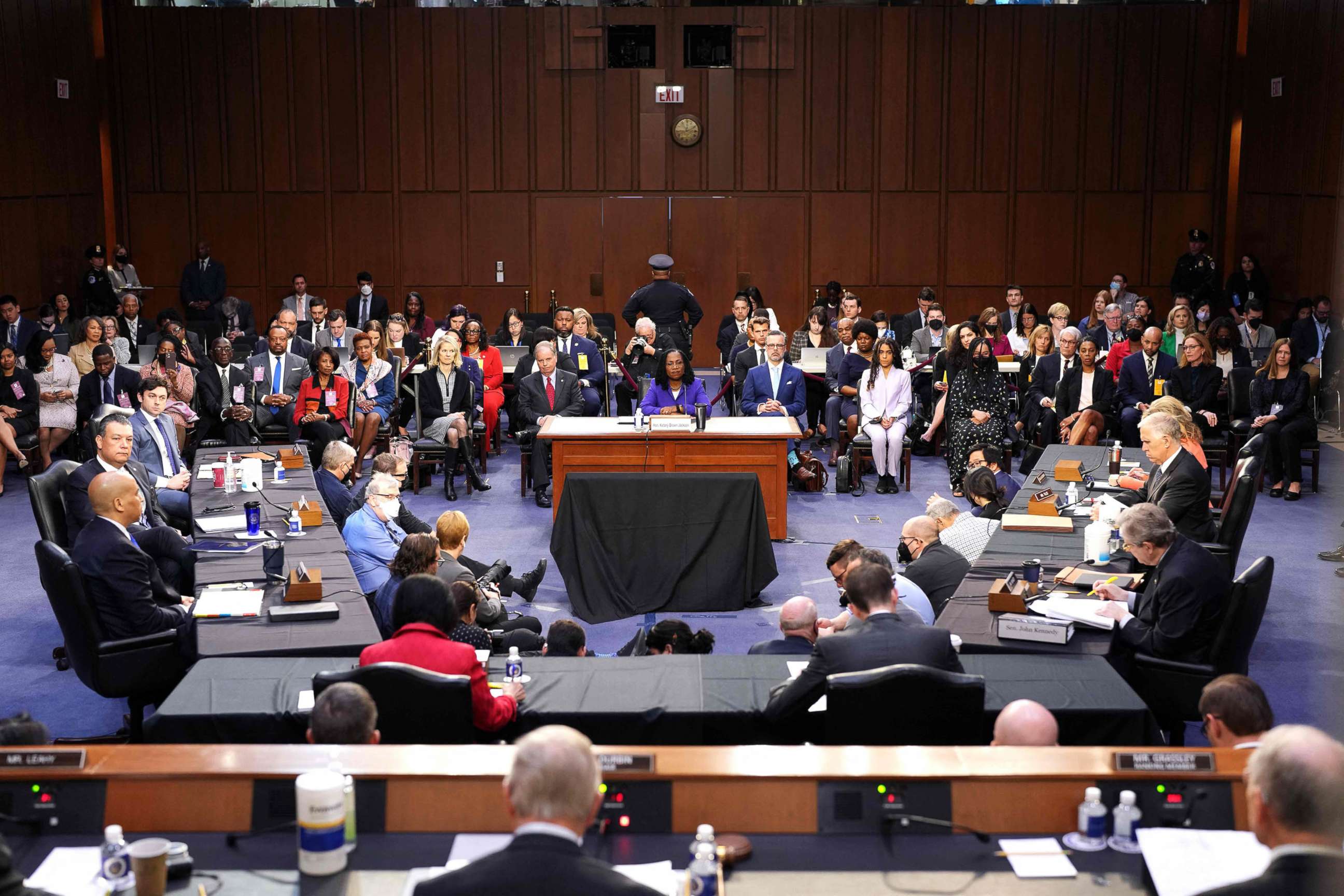
Supreme Court nominee Judge Ketanji Brown Jackson participates in her confirmation hearing before the Senate Judiciary Committee in the Capitol in Washington, D.C, March 21, 2022.
Doug Mills/POOL/AFP via Getty Images

He added that some argue federal sentencing guidelines are too harsh on child sex crimes, but Hawley made his disagreement clear.

"Judge Jackson has not had a chance yet to respond to this, and others have heard arguments, I don't agree with them, but I think it is important to hear from Judge Jackson, and we will have the chance to in the coming days," he said.

-ABC News' Trish Turner

Mar 21, 2022, 1:38 PM EDT

Confirmation hearings enter break

The Senate Judiciary Committee has gone into a 30-minute break following a morning of opening statements from Democrats and Republicans on the committee considering Jackson’s nomination to the Supreme Court.

After the break, seven more senators have opening statements to deliver before the public hears from two introducers and Jackson herself.

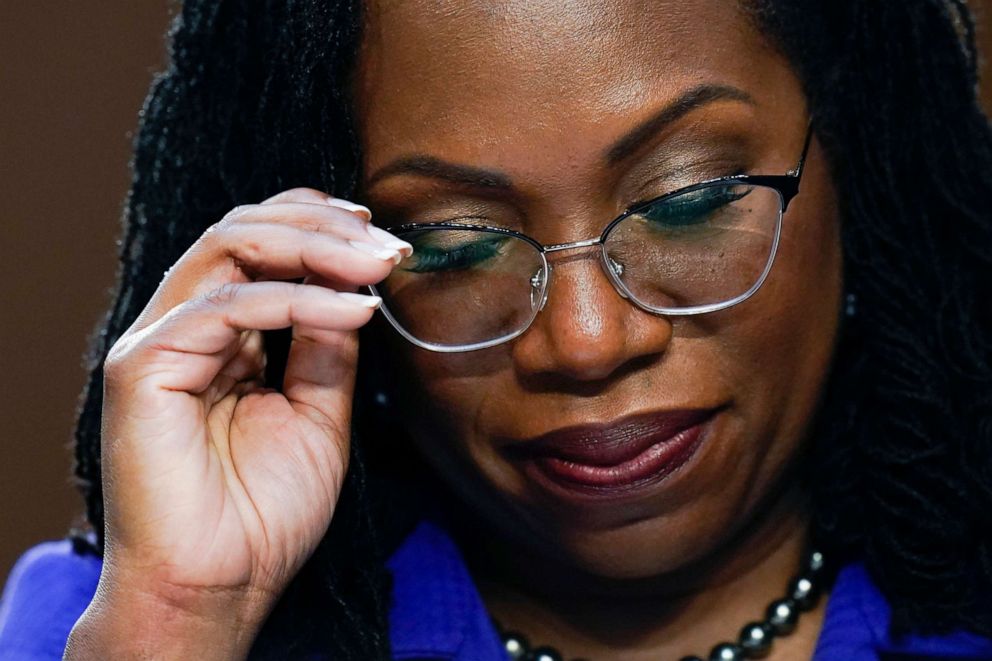
Supreme Court nominee Judge Ketanji Brown Jackson listens during her confirmation hearing before the Senate Judiciary Committee, March 21, 2022, on Capitol Hill in Washington.
Jacquelyn Martin/AP

Judge Thomas Griffith, formerly of the U.S. Court of Appeals for the District of Columbia Circuit, and professor Lisa Fairfax of the University of Pennsylvania Carey Law School will have five minutes each to introduce Jackson, whom they know personally.

Griffith often reviewed Jackson’s decisions as a trial judge while he served on the Court of Appeals and wrote to the Senate Judiciary Committee last month in support of Jackson's confirmation. Fairfax and Jackson were roommates for most of college and law school at Harvard University.

Jackson’s 10-minute opening statement will air on ABC News Television network with special coverage.

Mar 21, 2022, 1:35 PM EDT

Sasse raises the ‘Ginsburg rule’

The Ginsburg rule, named for the late Justice Ruth Bader Ginsburg who famously deflected senators' questions when asked at her confirmation hearings how she would rule on a hypothetical case, follows the thinking that justices shouldn’t hint at how they would rule because they should be open-minded when an actual case comes before them.

Sen. Ben Sasse, R-Neb., said in his opening statement that despite the Ginsburg rule, Jackson should be able to answer in detail questions about her own judicial philosophy -- and how she goes about deciding a case.

"It's incredibly important for a judge to tell us how she or he works out those principles in times that are new and confusing," Sasse said. "Unfortunately, too many of the court's decisions do not rest on solid constitutional foundations and reliable legal reasoning. Justices have too often written decisions to claim partisan policy victories and then retrofit bad legal or decision-making to justify that ruling."

Supreme Court nominee Ketanji Brown Jackson listens during her Senate Judiciary Committee confirmation hearing on Capitol Hill in Washington, D.C, March 21, 2022.
J. Scott Applewhite/POOL/AFP via Getty Images

"It’s for that reason that, while we should all respect the Ginsburg rule, the idea that judges sitting before this panel should not weigh in on hypothetical cases likely to come before the court, nominees do, nonetheless, have a duty to be very clear about their judicial philosophy, their legal views and interpretive principles," he continued. "The American people should not be asked to consent to any nominee who operates on principles that are obscure, confused or concealed."

-ABC News' Trish Turner

Related Topics

Sponsored Content by Taboola