'This Week' Transcript 6-28-26: New York City Mayor Zohran Mamdani, Sen. Mark Kelly & Sen. Todd Young
This is a rush transcript of "This Week" airing Sunday, June 28.
A rush transcript of "This Week with George Stephanopoulos" airing on Sunday, June 28, 2026 on ABC News is below. This copy may not be in its final form, may be updated and may contain minor transcription errors. For previous show transcripts, visit the "This Week" transcript archive.
(COMMERCIAL BREAK)
JONATHAN KARL, ABC “THIS WEEK” CO-ANCHOR: This morning, a “THIS WEEK” exclusive, New York City Mayor Zohran Mamdani on the primary wins that shocked his party. “THIS WEEK” starts right now.
(BEGIN VIDEO CLIP)
KARL: Kingmaker.
Mr. Mayor, how’s it going?
Mayor Mamdani on the movement shaking up the Democratic Party. A “THIS WEEK” exclusive.
Is this like a unique moment in New York, or is this the beginning of a national movement?
His response to critics in his own party.
MAYOR ZOHRAN MAMDANI, (D) NEW YORK CITY: We need a party that’s able to recognize the strengths of this economy and understand that it hasn’t reached enough people.
KARL: His message to Republicans.
Republicans are going to make you the poster child for the Democratic Party.
MAMDANI: Let them.
KARL: Breaking overnight, the U.S. and Iran exchange fire. Is the ceasefire in jeopardy? We have the very latest.
Overcoming the divide. Could military veterans help fix our broken politics? A conversation with two veterans on courage, civility and crossing party lines.
Doesn’t political courage often look uncivil?
SEN. MARK KELLY, (D) ARIZONA: You have to take stands that you know are the right thing for the nation.
SEN. TODD YOUNG, (R) INDIANA: It’s very difficult, this job, to navigate the shoals and assess, you know, the moral calculus of the moment.
UNIDENTIFIED MALE: America’s 250th.
KARL: As America prepares for its 250th anniversary, a sneak peek at an ABC News special, a year in the making.
We have been given special access to show you things about Rushmore that you have never seen before.
(END VIDEO CLIP)
ANNOUNCER: From ABC News, it’s this week. Here now, Jonathan Karl.
KARL: Good morning. Welcome to this week.
We will get to our exclusive with Mayor Mamdani in just a moment. But we begin with breaking developments overnight between the U.S. and Iran.
Let’s get straight to our senior White House correspondent Selina Wang.
Selina.
SELINA WANG, ABC NEWS SENIOR WHITE HOUSE CORRESPONDENT: Hey, Jon.
And these strikes just keep escalating. For a few days it was Iran hitting a tanker in the Strait of Hormuz, then leading the U.S. to retaliate. But overnight, Iran launched, not just drones, but also missiles towards Bahrain and Kuwait, which, of course, are home to U.S. military bases.
Now, so far, we are told by a U.S. official there have been no reported U.S. casualties or damage, but it does appear that each side is testing the others red lines.
Trump signed that ceasefire deal with Iran just over a week ago, and these strikes could make it that much harder to get to a longer-term deal that actually ends this war.
And it is clear as well, Jon, that Trump is losing patience with all of this. After the latest U.S. strike, he posted a warning that there may come a point when the U.S. can no longer be reasonable and will be forced to militarily complete the job.
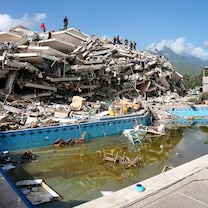
KARL: All right, and, Selina, another breaking development this morning. The U.S. is surging aid to Venezuela after those devastating earthquakes.
WANG: Yes, Jon, that’s right. The U.S. is sending in more search and rescue teams and bringing in military aircraft to help. Officials tell us that the top priority right now is pulling people out alive, out from under collapsed buildings.
And take a look at this video. This is video showing a U.S. team rescuing a mother and her baby from under the rubble.
The Trump administration is also preparing more financial aid, and that is on top of $150 million already committed, Jon.
KARL: Thank you, Selina.
In just six days, we celebrate the 250th year of the great democratic experiment that is America. And there’s much to celebrate. Against the odds, our founders defeated a monarchy and created what would become the richest, freest, and most powerful country the world has ever seen.
But as Americans gather across the country, recent polls show that a majority believe American democracy is not working well, and pride in America has fallen to a 25-year low.
And in Washington this week, that dysfunctional democracy was on full display. On the Republican side, the kickoff to a week of festivities to mark America’s 250th turned into a partisan political rally. And the fate of one of the precious few major bipartisan bills that we have seen in years, a plan to address the rising cost of housing, was cast into doubt when President Trump refused to sign it, demanding instead that Congress pass an entirely partisan bill that would change the way millions of Americans vote. And a Republican senator got in a shouting match with the Republican president.
We will get to all of that. But we begin with the explosive debate over the future of the Democratic Party. New York Mayor Zohran Mamdani, a self-described Democratic socialist, at the center of it all. Not even seven months into his term, he has emerged as a kingmaker of sorts in New York, taking on his party’s leaders in his state’s primary and winning across the board, even defeating two Democratic members of Congress. Some prominent Democrats are warning that Mamdani’s success could spell doom for their party in November, arguing that what works in New York City would be disastrous in the heartland. One group of moderate Democrats penning an open letter, saying, “We are capitalists, not socialists.”
We caught up with the mayor in New York to talk about how he plans to use his newfound clout, and how he’ll respond to those critics in both parties.
(BEGIN VIDEOTAPE)
KARL: You've had a heck of a week. I mean, the election, you -- the candidates you endorsed won down the line, and you knocked off two Democratic incumbent members of Congress. Is this, is this like a unique moment in New York, or is this the beginning of a national movement?
MAYOR ZOHRAN MAMDANI, (D) NEW YORK CITY: I think we are seeing a hunger that is not just felt by New Yorkers, but frankly by Americans from coast to coast, for a new kind of politics, one that puts working people at the heart of it. And I think for far too long what we as a party have been able to say to New Yorkers who are struggling is simply to explain why they're struggling, not actually offer them a vision for how to make life better. And these candidates -- Brad, Darializa, Claire -- they ran campaigns that spoke to working people, and that said life in the nation's most expensive city need not be this way any longer. And I can't wait to have them as partners in D.C. and at work.
KARL: So, do you see yourself endorsing candidates outside of New York? Or --
MAMDANI: You know, for now, my focus is on this incredible slate of three congressional candidates, as well as, as you said, the five candidates I endorsed, who ran and won, who are all going to be heading to Albany in the state legislature.
But I do think, as you said, it's not just New York City where working people are asking themselves, why can't I afford my rent, why can't I afford my groceries, why can't I find enough money in my pocket for childcare, no matter how hard I work? And I'm so excited that these incredible soon-to-be congressmembers will be helping to lead the fight across the country on making sure that working people are right there where they should be, which is the heart of the conversation.
KARL: The reaction from Democrats has been something. You've had some prominent Democrats dismissive of what happened here. I mean, you had Senator Blumenthal say, "The effort to nationalize New York is going to fail. What happened in New York will be really irrelevant by the time of the elections in November." Hakeem Jeffries basically said the same thing, saying that this is not indicative of what needs to happen in November. What do you make of that?
MAMDANI: You know, I think that when you ask Americans what they're feeling in this moment, amidst reports of an economy that's strengthening, of a stock market that's booming, you will hear an exhaustion at having to try and make ends meet every single day, every single week, every single month, and that it's getting harder and harder. And so, a message of fighting for working people, we don't have to nationalize that message. That is a national message. It's a national crisis. And for far too long, all we've had to say as a party is opposition to the current administration. What do we have to say beyond that?
And what these candidates offer is a vision that extends beyond the midterms, it extends beyond 2028. It speaks to what makes so many of us proud to be Democrats. It speaks to a vision that goes back to a New Deal understanding of what working people deserve. And I'll tell you that for too long that kind of politics, you can only find it in history books, and we need to bring it back to the present day.
KARL: And you're hearing some, not just dismissive, though, there's resentment. And this is from fellow Democrats who think that this could jeopardize Democratic chances in the fall. I mean, you got Josh Gottheimer, a Democratic member of Congress, says, “many of us believe, as do I, if you're a socialist, you are not a Democrat.” And in fact, they put out a manifesto today. Have you seen this thing?
MAMDANI: Sounds pretty socialist to me.
KARL: It's not a communist manifesto. It's a moderate manifesto. Saying, “we are capitalist and not socialist. We believe in a growing, fair, and competitive economy, entrepreneurship, ownership.”
I mean, this is a direct response, they've made it clear, to what you did here on Tuesday.
MAMDANI: Well, I mean, you know, that's great, but what's a party if not its voters? And I'm proud to sit in front of you as the mayor of our city, having received more than a million votes a little over -- a little less than a year ago.
And when we're talking about these incredible congressional candidates, they won their races, and they won their races with a vision of what politics should be, and one that actually speaks to working people. And for a lot of people who ask themselves, what does Democratic socialism mean, and you can tell them the answer at a theoretical level, it’s choice to extend democracy from the ballot box to the rest of their lives. But in terms of what it means over these last seven months, we've seen a city with Democratic socialist principles at the heart of it within our administration. And what we've delivered has been record lows when it comes to murders and shootings.
KARL: So is it pragmatic Democratic socialism?
MAMDANI: I think Democratic socialism at the heart is pragmatic, because if we cannot deliver for working people, then what is this for? I'm not interested in writing a manifesto or, frankly, in reading one. I'm interested in delivering, and that's exactly what we've been showing.
KARL: But they're saying that if you're a socialist, you're not a Democrat. I mean, is there room in the party for -- for both of these views?
MAMDANI: Yes, here I am.
(LAUGHTER)
MAMDANI: Here are so many more.
And I think what makes our party a beautiful party is the fact that it's a big tent that we have people --
KARL: But you've also said it has to be a party with a spine, with a backbone.
MAMDANI: Yes.
KARL: So it has to stand --
MAMDANI: Even a tent has to stay up.
KARL: Yes. So, you know, does it have to stand firmly for these ideas that you're talking about that others are calling dangerous?
MAMDANI: I think it has to stand for working people, and I think it has to be willing to fight for working people. And I think that there are some who are offended by the prospect of a party that knows who it fights for and goes every day to work for that, because what we've seen over many years is a willingness to not only explain away the status quo, but frankly, even to look to benefit from the status quo. And that's not what working people are looking for from our party.
KARL: As New Yorkers were going to vote, you said something interesting. You said, “The race for 2028 starts now,” the presidential race.
What do you -- what did you mean by that?
MAMDANI: Well, a lot of pundits asked me about this race and what it means, and how to think about it. And at the core of Tuesday's results was a message from Democratic voters across the largest city in the United States of America about the kind of politics they want to see, and we know that we oppose the cruelty of the federal administration.
What is it that we stand for beyond that?
KARL: So, you can't just be anti-Trump --
MAMDANI: You can't.
KARL: -- obviously.
MAMDANI: You got to have something you are not just willing to stand up for, but that you're also willing to explain how this is relevant to working people.
And I think this just comes back to the fact that I'm leading a city that's the wealthiest city in the wealthiest country in the history of the world. I could end the sentence there and say that life is great for eight and a half million people. But it's also a city where one in four are living in poverty.
And for far too many Americans, those contradictions have become their day-to-day life. And we need a party that's able to recognize the strengths of this economy and understand that it hasn't reached enough people.
KARL: Now, you know, there's been a lot of attention on one of the candidates you supported, one who knocked off an incumbent Democrat, is Darializa Avila Chevalier. She said some very controversial things, including calling for the abolition of prisons, couldn't say whether or not somebody who had committed murder should be in prison. Called for open borders. Against all deportations, including those of violent criminals.
Are those positions that the Democratic Party could win on nationally?
MAMDANI: I think what the Democratic Party can win on nationally is a focus on working people, and I think that what I saw from Darializa when I would walk the streets of her district was a focus on what she describes as the politics of life. She would talk about how we have to invest in babies, not bombs. She's now going to represent what is one of the poorest districts in the United States of America. And what people in that district are exhausted by is a politics that has justified the spending of tens of billions of dollars in killing civilians overseas, while working people are struggling just to do the basics.
KARL: But how does that -- how does abolishing prisons or having open borders fit into that? I mean, do you see how that's -- those are ideas that a lot of your Democrats that are warning about what happened here say are toxic, most of America won't go along with. They are bad ideas. They are dangerous ideas.
MAMDANI: I think what the focus of her race was, what the focus of her candidacy was, was about the struggle that working people are facing.
And I think that we can have disagreements on policy positions. What we have to agree on is what are we fighting for, and who are we fighting for? She showed that in her race, and I think that many people will come to appreciate that in her leadership to come.
KARL: So we can disagree on something as basic as whether or not there should be prisons?
MAMDANI: There --
KARL: That's not your position?
MAMDANI: There are prisons.
KARL: Yes.
MAMDANI: And what we're also showing in this city is that safety is not something that's up for debate. It’s something that we're actually delivering on. And I'm proud to be the mayor of a city that currently has the lowest recorded number of murders and shootings in recorded history in New York City.
KARL: So there was also a take -- it's not just Democrats. You probably heard what President Trump had to say about you and about the candidates you supported. And he warned that if socialists win -- and he calls you communists but -- you will start living in squalor, there'll be no food, no housing, no military, no law and order. There'll be nothing, and he had a few other choice words.
By the way, he also said he still likes you.
(LAUGHTER)
KARL: But what do you make of what he -- I mean, the Democrat -- Republicans are going to make you the poster child for the Democratic Party.
MAMDANI: Let them. We don't have to ask ourselves what life looks like if a socialist wins. I won last November, and over the course of these last six months, what we've delivered for working people are the very things we were told were impossible.
We've delivered free childcare for two-year-olds for the first time in New York City history. We've delivered tens of millions of dollars back to tenants who were taken advantage of by bad landlords. We've delivered 165,000 potholes being paved. And we've done all of these things while also delivering the lowest recorded crime in our city's history. That's what it looks like to have Democratic socialism. And what you're seeing is that New Yorkers experienced this for six months and made the decision that they wanted to see more of it on the national stage as well.
KARL: Can a Democratic socialist get elected president?
MAMDANI: I think a Democratic socialist can get elected anywhere across this country for any position. What I think we need to bring is a focus on working people.
KARL: And that's the direction that the party should go in, in terms of selecting a candidate for 2028?
MAMDANI: I think the direction that the party should go in is how best to fight for working people. I think we need to have a platform and a vision that doesn't sound as if it was cooked up by consultants, but instead one that you would say in response to someone who's asking, why can't I afford my rent, why can't I afford my groceries, why can't I afford my childcare? We need to make clear who we stand for, how we're going to stand for them, and that we're actually willing to fight for them when the going gets tough.
KARL: Obviously, Israel was a big issue in these races. Not the only issue, but a big issue. Is there room in the Democratic Party for candidates, officials who support Israel, not just support Israel, but support military aid for Israel? This was a huge issue for you.
MAMDANI: Well, I think what we've seen is that the time for us, as elected officials, to pronounce what the party should be is one that should come to an end, and we should let Democratic voters themselves take the lead. We've seen on Tuesday evening, we saw Democrats turn out in districts across the city to make clear that they were tired of tens of billions of dollars being spent in our taxpayer dollars to violate international law, to kill thousands of civilians. And you and I know that right now, the way that Palestine is described is as if there is a ceasefire. That's the language that's typically used.
KARL: Yes.
MAMDANI: More than a thousand Palestinians have been killed in that ceasefire. And what New Yorkers want to see is a politics of conscience, a politics of clarity, a politics of conviction. And to follow international law, to believe in the humanity of all people, it shouldn't be a journey too far. And I think that our party needs to hear what Democrats are telling them.
KARL: Democratic Socialists of America now says they no longer favor a two-state solution. Is that the way you see it as well, the idea of two states, Palestinian and Jewish states, side by side, living in peace?
MAMDANI: The way I see it is, equal rights for all people. And I think that that's the truth for Israel. It's the truth for any country in the world. And frankly, as we're coming up close to the 250th anniversary of our nation, one of the things that makes me proudest to be an American is the belief that equal rights are at the bedrock of our notion of what it means to be an American.
KARL: And the idea of a Jewish state, Israel as a Jewish state, that's in the charter, that's the way it is now. Do you support that?
MAMDANI: I've said time and again that I support the state of Israel as a state with equal rights. I believe that any state that --
KARL: But as a Jewish state is the question.
MAMDANI: I think any state that privileges one religion over the other is one that I can't tell you I support, whether it be Israel or Saudi Arabia or anywhere else. And a lot of that comes back to a fundamental belief that we should all be considered equal, no matter what our faith is.
KARL: How big a problem -- you've said it's rising -- is anti-Semitism in this city?
MAMDANI: We've seen anti-Semitism rise in this city. We've seen the fact that Jewish New Yorkers comprise a minority of our city's population, and yet continue to constitute a majority of the hate crimes that have been purveyed in this city. And that's something that's unacceptable. It's something that we will never come to see as if it is a part of life. It's something that has to be fought and rooted out of every one of the five boroughs.
KARL: What did you think when Dan Goldman -- that coffee shop in Brooklyn said that they didn't -- they wouldn't serve him because of his support for Israel.
Do you have a problem with – I mean, the idea of, you know, of an establishment like that saying they're not going to serve somebody if they support Israel?
MAMDANI: I've said that I have political disagreements with Congressmember Goldman. I do believe that that's a response that goes beyond that.
KARL: So, that's not the right kind of thing?
MAMDANI: No, I think -- I think it's much better to keep that critique in the way that we’ve done it.
KARL: OK, so we're just about out of time. I got to ask you, I noticed that you're turning 35 soon, right?
MAMDANI: In a few months, yes.
KARL: So, you now hit one of the constitutional requirements to run for president. But there's another one that says you have to be a natural born citizen. You were not born here.
MAMDANI: Yes.
KARL: But do you think that's a, that's a -- something that should be changed in the Constitution? It would take an amendment. But do you think that that's -- we should change that?
MAMDANI: No.
KARL: No?
MAMDANI: I think the Constitution looks good the way it is.
KARL: Just the way it is.
MAMDANI: Just the way it is. I'm very excited to focus on New York City. But thank you for reminding me of my upcoming mortality.
KARL: Thirty-five years old, 35 years old. All right.
MAMDANI: Yes, sir.
KARL: Mr. Mayor, thank you very much.
MAMDANI: My pleasure.
KARL: All right. And up next, the prominent figure in the MAGA movement, somebody who was sitting next to President Trump at the Republican convention and who now says there is no chance that he will support the Republican Party again. That and much more with the roundtable when we return.
(COMMERCIAL BREAK)
(BEGIN VIDEO CLIP)
J.D. VANCE, VICE PRESIDENT OF THE UNITED STATES: I'm actually fascinated by Nixon as a character in history. I think that his historical legacy is enjoying a bit of a Renaissance but I think deservedly so. As I joked with Robert backstage, if Watergate happened tomorrow, it would be like a 12-hour news story. Like the idea that it would have taken down a presidency is crazy.
(END VIDEO CLIP)
KARL: All right, the roundtable is here. Our congressional correspondent, Jay O'Brien, SCOTUSBlog editor Sarah Isgur, editor of the "National Review," Ramesh Ponnuru and Center for American Progress CEO Neera Tanden.
Neera, let me start with you. You've worked with people that went by the name Obama and Clinton. You've worked with the Democratic establishment. So who's right? Is this movement in New York kind of isolated to a few very liberal parts of the city, or is it a national movement?
NEERA TANDEN, CENTER FOR AMERICAN PROGRESS PRESIDENT AND CEO: Well, I think what we saw on Tuesday was, in New York City, very liberal candidates won in a very liberal place. But the party also put up moderate candidates to go in to compete in swing districts. But, you know, when Mayor Mamdani talks about a politics of working people and lowering childcare costs and lowering the rent and addressing public safety, you know, that's a message that I think actually resonates with a lot of Democrats.
There's some candidates on Tuesday night who had some more extreme views. You mentioned those views. Those -- I think a lot of Democrats, when they're asked are going to say they disagree. But when candidates are asked about universal child care, that's been a position of the Democratic Party for at least a decade. Joe Biden campaigned and tried to do that. So I think when you're talking about those issues, there's a lot of unity in the Democratic Party, and some of these positions, there's going to be a lot more criticism.
KARL: Sarah, it is astounding. This is a guy who's 34 years old, new to politics on a stage anything like this. And he has been hammered this week by both the Democratic establishment and Republicans. And he seems entirely unflappable. And he's right -- seems like he's riding high.
SARAH ISGUR, ABC NEWS CONTRIBUTOR: I mean, this is a talented guy. Like, dismiss him, you know, at your peril as Democrats just learned. But what's interesting is, you know, that whole interview, he is very on message, right? This is about working class voters, working class, working class. But that's not actually how they won these primaries. It is the whiter, wealthier members of these districts who voted in these very extreme candidates.
KARL: These are poor districts, not the poorest in the city.
ISGUR: But the more multiracial, the more working-class parts --
KARL: Yeah.
ISGUR: -- of the district voted for other candidates. And I think that's the danger for Democrats moving forward is that --
KARL: This is an elitist movement actually of --
ISGUR: Yeah, the Democratic Party overall is getting whiter and wealthier, and the Republican Party is getting actually closer to the working class and we've seen the two parties realign over the last 10 years. And a lot of both parties don't seem to recognize what that actually means for voter turnout, for grassroots building because they think they're still living in a Reagan Republican Party era.
KARL: It is interesting that there was another race in New York, congressional primary. Ritchie Torres, progressive Democrat, who was also one of the strongest supporters of Israel in Congress -- absolutely unapologetic supporter of Israel -- ran against challenger who made that an issue when he won by 50 points, in a district that's poor.
RAMESH PONNURU, NATIONAL REVIEW EDITOR & ABC NEWS CONTRIBUTOR: Yeah, you know, I don't think that most voters in the United States are actually as obsessed about foreign policy and the Israel policy in particular as the political conversation often is. What strike me particularly about the Goldman-Lander race where you had Israel as -- at the forefront of that race is part of what's going on here is Democratic voters are frustrated at the failure of the party to effectively fight Trump.
And Goldman, of course, helped lead impeachment against Trump, but I think a lot of Democratic voters look at all of those efforts and say, yeah, but Trump survived impeachment.
KARL: It didn’t work. It didn’t work.
PONNURU: So, it didn't work. Trump's back -- got back in power, has been able to achieve a lot of things that we don't like, and there's this degree of frustration that I think was part of the explanation for what happened in those primaries.
KARL: And, Jay, he went up against the Democratic establishment. He went up directly against Hakeem Jeffries who supported these incumbents.
And now, we saw Senator Elissa Slotkin come out this week and say that we need new Democratic leadership including, she suggested, Jeffries. How's that playing? You know, where does that stand?
JAY O’BRIEN, ABC NEWS CORRESPONDENT: I mean, this is going to be a headache for Hakeem Jeffries no matter what. The question is how big of a headache is it going to be?
As Neera said, candidates up and down Democratic ballots are going to be asked about the positions of these Mamdani candidates.
But then the question is how far does this go to trouble Hakeem Jeffries if they take back the House as they're kind of an insurgent movement to not elect him as the leader? Or even if he becomes the leader and the speaker, then what happens?
Because he's still got a very fractious Democratic Caucus here and Hakeem Jeffries claim to fame with that caucus is his ability to manage it. So if you've got louder voices who are not the majority of the caucus, but make more of a problem for him, it undercuts his, again, claim to fame, which is ability to manage all the voices in the caucus.
ISGUR: Ask Paul Ryan how that went, right?
O’BRIEN: Exactly.
ISGUR: This is a mirror of what happened with the Tea Party --
KARL: Freedom Caucus.
ISGUR: -- Movement taking over the Republican Party slowly and then all at once.
After Mitt Romney lost in 2012, they reject the Republican autopsy and everyone's like, oh, this will hurt them nationally. Donald Trump wins.
This is the weakness of political parties today. We're in this very partisan moment, but the political parties themselves have no power over who their standard-bearers are going to be.
NEERA TANDEN, CENTER FOR AMERICAN PROGRESS PRESIDENT & CEO: The only difference I'd say is back then Republicans were putting up some of their most extreme candidates in races -- in swing races. That's how Senator Reid got reelected against Sharron Angle for anyone who can remember that. And here, Democrats --
(CROSSTALK)
ISGUR: Let me introduce to Maine.
PONNURU: Maine and Michigan.
(CROSSTALK)
TANDEN: I will say --
PONNURU: -- are the test cases there.
TANDENT: We will see -- we will see what happens. But Caitlyn (ph) Conley, others have won. Even last week, can -- Democratic voters voted for candidates like Cait Connelly and Nancy Lacore in South Carolina and New York 17, who they believe have the best chance, who are moderate candidates who have the best chance of knocking out Republicans.
Voters in the Democratic Party are still to this day mostly voting for candidates who can win and swing elections, and also represent --
KARL: But Maine and Michigan are test cases.
TANDEN: These are questions.
KARL: Yeah.
TANDEN: And Michigan will be a test case in the future and Maine is the test case as well.
But overall, these candidates -- and also -- I mean to say it, Platner was doing better against Susan Collins in the polls than Janet Mills was, and that is the question.
KARL: So, can I switch to -- from Democratic dysfunction to Republican dysfunction for a second? I just want --


TANDEN: Please?
(LAUGHTER)
KARL: I just want to play something from Tucker Carlson, you may remember him, this week. Take a listen.
(BEGIN VIDEO CLIP)
TUCKER CARLSON, FORMER FOX NEWS HOST: I would not support the Republican Party. There's no chance I would support the Republican Party. Not going to support the Democratic Party. I don't know what I'm going to do.
But at this point, you know, how could you support -- how could I or any American voters support a political party that's not loyal to the United States?
(END VIDEO CLIP)
KARL: All right, and Marjorie Taylor Greene, you also remember her, responded to that on X saying that: There are a lot of us absolutely fed up who will not support a party that betrays its voters and its country. We are done with the America last Republican Party.
Let's start with you, Sarah. Does it matter?
ISGUR: Yes and no. Right? These two people do not matter. But again, you are seeing a political party lose control over what it is and what it stands for, and this is part of the fracturing of that whole movement. And we're not even at horseshoe politics anymore. I think it's just a full circle at this point.
And so, the anti-semitism on the left and the right, the obsession with Israel that is not actually about foreign policy, or else you'd see a whole bunch of other countries involved in this, the amount of money that is being spent on Israel is a fraction of a fraction of a fraction of anything these people are talking about.
It is a dog whistle because it is easier to form a coalition against something, about hating something than it is to be for something. And that's what our whole government is right now, is against, instead of actually doing things.
KARL: But, Ramesh, let me get to Tucker Carlson specifically for a second, because this is not just any, you know, influencer. This is a guy who was very close to the president. As I mentioned, sat next to him in the presidential box at his convention, visited the White House a lot over the past year, very close to J.D. Vance. What does this do to J.D. Vance? Because he is still very close to J.D. Vance.
RAMESH PONNURU, NATIONAL REVIEW EDITOR & ABC NEWS CONTRIBUTOR: Well, I think one of the things that's happened here is Tucker Carlson has had a huge audience, but he has vastly overestimated how many Americans he speaks for. So has Marjorie Taylor Greene. And I think we saw that, particularly at the beginning of the Iran war.
Now, I didn't think this was a particularly wise war, but the fact is, the vast number of Republicans supported it, and it didn't matter what Tucker Carlson had to say. The question for Vance, I think is, to what degree does he get misled by online popularity into catering to a segment of the party that is not representative of the Republican Party, let alone the public at large?
KARL: And Jay, what a week on Capitol Hill. I mean, the president up against the Republican leadership. I've never seen John Thune look more uncomfortable when Trump suddenly pulled the plug on the Housing Bill that had just passed.
JAY O'BRIEN, ABC NEWS CORRESPONDENT: Well, when you think about the people, Marjorie Taylor Greene, Tucker Carlson, and Sarah said do not have power, there are people on Capitol Hill who very much do. And they're not turning against the party, but they are turning against President Trump.
They've been called the YOLO caucus, right? It's these members that --
KARL: YEAH.
O'BRIEN: -- Donald Trump viewed as disloyal. He primaried out, and he caused himself an issue here, because they're going to be Senators.
(CROSSTALK)
KARL: Cassidy, Cornyn.
O'BRIEN: Tillis, to a degree --
(CROSSTALK)
KARL: (inaudible).
O'BRIEN: -- not primaried, but not running for re-election. That is a crew. They're going to be Senators until January. So they are going to be able to throw sand in the gears of what Donald Trump wants to do. And they have already shown that they're willing to do that, and they're emboldened.
Think about Bill Cassidy yelling at Donald Trump in a closed-door Senate lunch.
KARL: A screaming match.
O'BRIEN: -- that is something -- in a shouting match. Trump called him a lunatic. Cassidy called him brother. Trump said, I'm not your brother. Point is, that would have been unthinkable a year ago.
NEERA TANDEN, CENTER FOR AMERICAN PROGRESS PRESIDENT & CEO: Yeah, I mean, I think both of these things are an indication. You know, we talk about the politics of these people and their personalities, but what you're actually seeing is Republican voters.
I mean, Trump is losing some voters who voted for him three times. I think the Iran War is a huge part of that. They did not expect the Iran War. They're paying for it. You're seeing cracks in his coalition.
That's why I think Tucker Carlson is actually important. Because it's not Tucker Carlson per se. But he's actually representing his own, a group of people who've already fallen away from the president. And I think what's really under-discussed is how angry people are about the Iran War.
That no one expected this war, and it is a war that we seem to be losing. And we're all paying for it. That is a failure that is going to have consequences for the president, not just with Democrats or Independents, but with Republicans.
ISGUR: The question for Republicans is, when does Donald Trump, or did Donald Trump, become a lame duck? And who's going to step in? Because as soon as J.D. Vance steps up, Donald Trump's going to attack him. And so nobody is trying to run for president for 2028 on the Republican side.
(CROSSTALK)
KARL: You think he's going to attack J.D. Vance?
ISGUR: Absolutely. To prevent himself from being a lame duck? Yes. But you're seeing now these lame duck Senators. And remember, the magic number is four. That's how many Senators Republicans can lose before they no longer have a majority. You named three. I'll add McConnell to that. And we're at four. And Donald Trump doesn't seem to recognize that or care.
PONNURU: The other thing is, the number one issue that got Trump elected was the cost of living and inflation. And Trump has not only taken steps that make that worse, the Iran War being prominent among them, tariffs being another, but he has just very visibly demonstrated that he doesn't care about this question.
He has explicitly been saying, I don't care about it.
KARL: Although he sure seems determined now to end the war. I mean, how many provocations can he say, you know?
PONNURU: Right. But after a year, when the top issue for the public was very obviously less important to him than renovating the East Wing, I think it becomes very difficult to say, we have the voters' interests in mind.
O'BRIEN: He canceled the signing of the Housing Bill. And that is a cost of living issue.
PONNURU: Right.
O’BRIEN: A bipartisan piece of legislation.
ISGUR: That his own Whtie House --
KARL: And attacked it as the Elizabeth Warren bill, even as the others praised it.
PONNURU: And he’s doing it because of an issue about election law that most Americans aren’t focused on, but Trump himself cares deeply about.
NEERA TANDEN, CENTER FOR AMERICAN PROGRESS PRESIDENT & CEO: I mean, you just forgot the most important thing that he’s been focused on, which is the Reflecting Pool.
PONNURU: Right.
TANDEN: That is another area that’s got a lot of his attention as well.
KARL: A couple -- very quickly, what about that Nixon comment from J.D. Vance?
PONNURU: Well, its’ interesting because for many years the Republican Party revered Reagan much more than Nixon, partly because Reagan was a successful president and Nixon, of course, ended his presidency in disgrace. But there’s been a concerted effort by people around Trump to kind of move away from Reagan, the small government message, the optimism, the pro-growth orientation. None of that is really central to the Trump/Vance brand. And they want to kind of erase that legacy and replace it. And I think that’s what this is about (ph).
KARL: It’s now the party of Nixon. We can get our Nixon tattoos.
ISGUR: Nixon, the last liberal president.
KARL: OK. All right. Up next, my conversation with senators Mark Kelly and Todd Young about the challenges of bipartisanship in the current moment. We’re back in two moment -- two minutes.
(BEGIN VIDEO CLIP)
KARL: How hard is it, in this administration, Senator, to take a stand against this president?
SEN. MARK KELLY, (D) ARIZONA: Well, I think it’s hard.
(END VIDEO CLIP)
(COMMERCIAL BREAK)
KARL: “Courage Can Save Us.” That’s the title of a new book on veterans in Congress who have shown courage both on and off the battlefield. Author Rye Barcott profiled five Republicans and five Democrats who he says have the courage to meet the moment.
We spoke with Rye, Senator Mark Kelly and Senator Todd Young about how they are trying to bridge the divide and fix our broken politics.
(BEGIN VIDEOTAPE)
KARL: You are recruiting and supporting veterans who want to run for office, who meet certain criteria against bipartisan. It’s not ideological. Because you believe, and you believe there is evidence that military veterans are more likely to show the kind of political courage and also to cross party lines.
RYE BARCOTT, AUTHOR, 'COURAGE CAN SAVE US" & WITH HONOR CO-FOUNDER AND CEO: That’s exactly right. So, With Honor has helped support over 100 veterans. There are about fifty that are currently in Congress. And they take a pledge to serve with integrity,
civility, and courage, including the courage to work across party lines -- not necessarily agree with every policy -- but to maintain that trust to address matters that really are important to the country.
KARL: Senator Young, you served in the Marines. How does that service inform what you do here? This is a very different kind of courage.
SEN. TODD YOUNG, (R) INDIANA: It is. This sort of courage, in some respects, is one that's less familiar to many people. It's -- it’s the courage to be misunderstood by people you respect and love and whose values you share on difficult issues. It's courage to do unpopular things and to be held to account or to be able to persuade people so there's uncertainty and risk associated with those sorts of things.
But I feel like that sort of courage, which is emphasized in military service, is necessary in order to serve the common good in divided times. People don't send us here to be influencers. They don't send us here to make political statements. But in the end, they send us here to solve hard problems working with people who don't always see the world the same way we do.
KARL: The argument that the book makes is that, again, courage and civility -- only courage and civility will save us. But doesn't political courage often look uncivil?
I mean, you need to stand up. You need to go up against the prevailing view. You need maybe to stand against somebody in your own party.
SEN. MARK KELLY, (D) ARIZONA: You also have to do stuff that also might not be in your own personal best interest --
KARL: Yeah.
KELLY: -- at times in this job, in the United States Senate. You have to take stands that you know are the right thing for the nation that moves us forward in a positive way, but could be politically harmful to you and your career. That's hard for some folks.
KARL: Well, let's get to something uncomfortable here. Senator Young, what was your reaction when the president of the United States accused Senator Kelly of sedition, punishable by death, when the secretary of defense tried to punish him --
YOUNG: I'm glad you asked.
KARL: -- because he made a video telling --
YOUNG: Yeah.
KARL: -- the message that people shouldn't, members -- service members shouldn't obey unlawful orders.
YOUNG: So, as Mark can share with you, my first reaction was to text Mark and engaged in a dialogue that very morning. And we had an exchange back and forth, an exchange which I will keep private about what I should do, how I should respond, where this led, and so forth.
And so it demonstrates that it's really important to develop trust among your colleagues in solidarity, even during what I know was a difficult time for -- for Mark. And I like to think, because we've developed that partnership, it leads to constructive action on things like shipbuilding.
These are difficult times. They're difficult times for people --
KARL: But can I just press you for a second? Because it seemed like --
YOUNG: Of course.
KARL: -- it seemed like a pretty outrageous thing, the president of the United States suggesting that this senator next to you could be put to death for something he said. And there wasn't much of an outcry among Republicans in Congress over that. It was a kind of like --
YOUNG: Oh, it does lead to a larger question, which is, why am I here, Jonathan?
KARL: Yeah.
YOUNG: Am I here to -- to hold forth every time I have a concern about utterances or even actions, but render myself unable then to work on broader initiatives that are important to my constituents, on behalf of my constituents in the country, or am I here to narrate a presidency?
There are times -- there are times when one must speak up when you feel strongly about things. That was a case when one could fairly say that should have been the singular moment.
But just keep in mind that there are trade-offs -- and this gets back to what Mark was talking about. It's very difficult this job to navigate the shoals and assess, you know, the moral calculus in a moment and assess when you should go to the wall, so to speak.
KELLY: Jonathan --
KARL: Yeah?
KELLY: -- I had one of my colleagues who I won't mention who it was, but said, “Hey, this is a food fight. When this turns into a knife fight, I will say something.”
So there's a little bit of that. I mean, sometimes this feels like a knife fight for me. I've been to --
KARL: I mean, when the president of the United States is saying you could be put to death --
KELLY: Well, also when you find out that they -- they're in front of a grand jury.
KARL: Right.
KELLY: And by the way, they don't --
KARL: Tried to indict you and failed.
KELLY: Yes. Yeah. For seditious conspiracy.
KARL: Yes.
YOUNG: Let me add this, I've had conversations with the White House --
KARL: Yeah.
YOUNG: -- since this episode played out in a very public way. And the question was naturally, we've been working on the shipbuilding initiative. Is it going to be a problem that I'm working with Senator Kelly in this initiative because we're investing a lot of time and energy on this? And the answer was no.
No, we think it's important that ships be built. We welcome your collective efforts, your bipartisan efforts.
(CROSSTALK)
KARL: So, go work with the guy that we're accusing of seditious conspiracy.
YOUNG: And so, it is -- it is complicated. There's no question.
KELLY: Well, you got to compartmentalize.
YOUNG: That's right.
KELLY: We're all adults. We understand the complexities of our own individual politics and certainly how complex it is, especially for Republicans with this administration in particular.
KARL: Yeah.
KELLY: It's not -- it's really not -- it's -- I'd say in this situation, it's easier to be in the minority.
KARL: Yeah.
KELLY: To be in the majority and the leader of your party is fair to say, very unconventional about how he approaches this job. It is very complicated for them.
KARL: Well, look, you as a newly minted Senator took on the president of your own party over immigration.
KELLY: Yeah.
KARL: I mean, you were barely in the Senate.
KELLY: Right.
KARL: And it was an unpopular view. I mean, it's written about -- you write about it in the book.
KELLY: Yeah. And he I mean -- he created or responsible for, I think, is really fair to say.
KARL: Yeah.
KELLY: I think it's also fair to say create created a crisis at the southern border by and --
(CROSSTALK)
KARL: With how he handled the --
KELLY: Yeah, the Biden administration did a bad job at the border. Now, I am a border Senator. I represent the state of Arizona. And this was affecting my constituents more than it was affecting, let's say, Todd's in Indiana.
KARL: Yeah.
KELLY: So, yes, I wound up in a situation with them where I had to do some unpopular things and I think unpopular things for being a Democrat.
KARL: Right. And you took heat. But how hard is it in this administration, Senator, to take a stand against this president?
KELLY: Well, I think it's harder.
KARL: I mean, we've seen -- I mean, you've seen two of your colleagues lose primaries, two sitting Senators lose primaries because the president of the United States didn't support -- supported their opponent.
YOUNG: Well, in a sense, you can't fault the president for using the leverage he has to affect the agenda he was elected to implement. He is a master of social media. He has more loyal political followers than I've ever encountered in political life. And he's used those.
We've never seen a president have those tools, have that sort of leverage against Congress before in my lifetime. And so, does it require a more sophisticated, more nimble sort of public leadership?
I think it does. Yes. But that in no way absolves myself or any of my colleagues, Republican or Democrat, from the agency we have. We still need to sacrifice when we feel like the common good can be advanced through personal sacrifice.
KARL: Yeah.
YOUNG: We still need to cast principled votes and work on ambitious projects and make those arguments. And I've attempted to do that.
KARL: How does this all look at America 250, which -- the celebrations itself are being politicized?
KELLY: You know, we are clearly very divided.
KARL: Yeah.
KELLY: Americans are not optimistic at this point. Congress is deeply unpopular. My view on this, and I'm sure, you know, Todd might disagree, is that we have a president that looks for -- looks at every opportunity, not as an opportunity to bring the country together, but to further divide us.
And even this 250th celebration, this is really an opportunity to think about like the history of our country and all the great things we've done, all the innovation. But what's going to happen on July 4th?
KARL: Yeah.
KELLY: We're going to have a rally.
YOUNG: Well, Mark was kind to recognize that I would have a different perspective, and he's not wrong. I do have a different perspective.
KARL: Yeah.
YOUNG: I think that lets our country off a little too easy. I think the reason we're so divided right now and the reason we have a government that we're unhappy with is because the American people have elected the current crop of Senators, of Congressmen, of --
KARL: The president.
YOUNG: -- of the president, all of us, and they haven't demanded more of us. I mean, really, this is in the American people's hands. You ask about the 250th. This is an experiment. It is a fragile experiment. And it only exists if the American people take
command of this country. And if they have challenges with the way we're being led, then put people in office that can do a better job. So it's in the American people's hands.
(END VIDEO CLIP)
KARL: Well, it's hard to argue with that.
Ahead, from sea to shining sea, celebrating 250 years of America with a sneak peek at an ABC News project a year in the making.
(COMMERCIAL BREAK)
KARL: In advance of America's 250th birthday, ABC spent the last year exploring some of the most awe-inspiring places in our country.
(BEGIN VIDEO CLIP)
DAVID MUIR, ABC NEWS ANCHOR: America's 250th were high atop New York Harbor here. Our team across this country, celebrating the wonders of America.
KARL (voice-over): Visiting the wonders of America from the beauty of our national parks.
UNIDENTIFIED MALE: Spectacular.
KARL: To our most extraordinary human creations.
DIANE SAWYER, ABC NEWS ANCHOR: This place is going to astonish you.
KARL (voice-over): Bringing you the best of what America has to offer.
ROBIN ROBERTS, ABC NEWS ANCHOR: Oh, my god.
(END VIDEO CLIP)
KARL: As part of this project, I took on one of the coolest assignments of my career, an extremely rare look at Mount Rushmore and the colossal heads of Washington, Jefferson, Lincoln, and Teddy Roosevelt, carved into the granite of the Black Hills. A chance to show you what the shrine of democracy looks like from the top of the mountain, and something few people have ever seen.
The deep tunnel carved into the granite behind Mount Rushmore, and what was to be the Hall of Records. Now an unfinished tribute to the founding of our country. Deep inside that tunnel, we found some of the original drill bits used to create Mount Rushmore.
(BEGIN VIDEO CLIP)
KARL: Wow. I mean, this is just incredible. We've got Abraham Lincoln's nose right over there. Jefferson?
UNIDENTIFIED MALE: Does it ever get old for you to be up here?
KARL: Never. No.
UNIDENTIFIED MALE: We're on top of Mount Rushmore.
KARL: It's unbelievable, isn't it?
This was going to be the place that stored America's most treasured documents. What the Bill of Rights, the Declaration of Independence, the Constitution, the Gettysburg Address were all going to be here on display.
(END VIDEO CLIP)
KARL: You can see all of that and more from all 50 states during our 24-hour America 250 special across all Disney platforms next Saturday.
We'll be right back.
(COMMERCIAL BREAK)
KARL: Before we go, we want to take a moment to remember a special member of the ABC News family.
Maksym, Max Oseredchuk was killed this week by a Russian drone strike. Max had served as a producer, a driver, and a guide with our teams in Ukraine, helping keep our teams safe during Martha Raddatz's many visits to Ukraine for this program.
He was cheerful and professional, despite dealing with the constant pressure of war. As Martha put it, we could leave, he could not. He loved his wife and daughter beyond words. We all loved Max.
Max, who had a Master's Degree in Economics, began his work as a journalist after the Russian invasion of Ukraine in 2022. Just a few months ago, he joined the Ukrainian military. Max was only 30-years-old.
He leaves behind his wife, Kateryna, and baby daughter, Maria.
We'll be right back.
(COMMERCIAL BREAK)
KARL: And that is all for us today. Thank you for sharing part of your Sunday with us. Check out "World News Tonight" and have a great day.
(COMMERCIAL BREAK)

Popular Reads

ABC News Live